

The O:JA&L Masters Series
Poetry: All forms & styles
Cowboy Poetry
An Essay on Craft
Featured Writer: Rod Miller
Fine Lines & Wrinkles
Click on the title SADDLE WORK to explore or download Rod Miller’s free PDF chapbook
available now in the the 2026 O:JA&L Masters Series.
Cowboy poetry is a genuine form of occupational folk art, shaped by the realities of ranch life. Born along historical cattle trails and on isolated prairie ranges of the trans-Mississippi West, these verses capture the daily labor, triumphs, and hardships of agricultural work. It transforms routine ranch duties into enduring oral literature, proving that art thrives directly in the workplace.
Cowboy poetry lives not merely in rhyme or story, but in the precise turns of language that make a line linger. In this essay, Rod Miller considers the craft behind memorable poems, arguing that the best work depends on “fine lines” shaped by sound, rhythm, image, and exact word choice, as well as “wrinkles” that surprise the reader with originality and wit. Through examples from respected cowboy poets, he shows how careful attention to language can lift verse into poetry, and he invites writers to read deeply, listen closely, and learn from those who have done it best.
This essay was first published by Cowboy Poetry.com and was re-printed in Rod Miller’s essay collection A Cowboy Poet’s Handbook. The Handbook is out-of-print, but PDF copies are available by emailing writerRodMiller@gmail.com.
IT DOESN’T TAKE MUCH TV TIME to realize that the words “fine lines and wrinkles” strike fear in the hearts of folks with an unhealthy obsession with their faces. But I won’t be talking about faces or lotions and potions, creams and concoctions formulated to reduce or eliminate the appearance of fine lines and wrinkles.
Far from it.
I am, in fact, in favor of fine lines and wrinkles. I urge, encourage, advocate, and campaign for their appearance in cowboy poetry whenever and wherever possible. For those two characteristics—fine lines and wrinkles—are the very qualities that set poetry apart from and above mere verse, rhymes, and doggerel.
By “fine lines,” I mean a collection of words and sounds strung together in an arrangement that is as near perfect as humankind is capable of making. Lines that say something so well, that sound so good, it is simply unthinkable to change a single syllable, never mind a word.
By “wrinkles,” I mean unexpected turns of phrase, unusual usages, warped verbiage, twisted expressions that surprise and delight and make the best poems memorable, even unforgettable.
Mark Twain summed it up well with his famous and familiar phrase: “The difference between the right word and the almost right word is the difference between lightning and a lightning bug.”
To further the lightning analogy (and mix our metaphors), bolts of brilliance do strike twice—and more—in the same place. That is to say, most fine lines and wrinkles demonstrate more than one poetic quality, and that’s what puts them over the top, pushes them into the rarified air where brilliance breathes. Take your pick: word choice, word order, sounds, relationships among sounds, cadence, rhythm, contribution to meter in formal poems, inventive yet apt rhymes, unexpected turns of phrase, surprising metaphors, and on and on. Look closely and carefully at any highly regarded cowboy poem and you’ll find a number of these lightning bolts electrifying the words and sparking the syntax.
Etching, in other words, fine lines and wrinkles into the poem.
What follows is a collection of the kind of fine lines and wrinkles I’m talking about, chosen as examples for one simple reason: I like them.
That said, all are from acclaimed poems penned by respected cowboy poets, living and dead. And all can be shown to demonstrate the qualities that make poetry poetry, rather than just words wrapped together with hay wire.
Let’s start with an example from consensus master poet Charles Badger Clark.
Countless poems include references to death. In fact, it’s probably a part of more poems than any other subject, save love. (Given the cultural cowboy reticence about romance, death may actually be more prevalent than love in cowboy poems.) Think of all the colorful phrases you’ve heard cowboys use to describe dying: the end of the trail, the last roundup, the campfire has gone out, and dozens, if not scores, if not hundreds of other eloquent ways.
But for my money, no one has ever said it better, and few have said it as well as these fine lines from “Ridin’.”
When my earthly trail is ended
And my final bacon curled
The magical comparison of death to cured and fried sowbelly is surprising, even shocking—not to mention witty—in its originality and rightness. A perfect example of a wrinkle if ever there was one. Notice, too, how soft sounds parade through these fine lines until the end, then explode in a big climax with the “k” sounds of the hard “c” in bacon and curled, lending emphasis to the metaphor. The sneaky little rhyme shared by “earthly” and “curled” contributes to the beauty. Fine lines, by any measure.
I have run on middle fingernail through Eolithic mornings
That opening line from Joel Nelson’s “Equus Caballus” sets the stage for one of the truly remarkable poems for our day. But, even in isolation, that single line is a glorious thing. One is immediately taken with the flawless trochaic foot that clip-clops through the line. But what really smacks one upside the noggin are the phrases middle fingernail and Eolithic mornings. Both are actual and factual descriptions. So why, in all the thousands of poems written about horses, have few poets called the hoof a middle fingernail? Eolithic alone is a curious and striking word. Pairing it with mornings adds a touch of romance, evoking rising mists and sparkling fresh air—the kind of unanticipated wrinkle that makes the line fine.
Paul Zarzyski’s “The Hand” erupts with anger. But vitriol cannot disguise the beauty of the language. These fine lines are indicative:
…just another wind-burned hand
of a cavvy man, sinew and knuckle,
flesh and blood, pocked, porous, scarred,
and dark as lathered latigo.
The most interesting characteristic of these lines is the interplay of sound. First, there’s the short “a” procession: hand, cavvy, man, and, and, and, as, lathered, latigo. There’s no way a string of nine of the same short vowel sounds found themselves in those four short lines by accident. Then there’s the equally impressive consonance of the “k” sound in cavvy, knuckle, pocked, scarred, dark; still more correspondence of “L” sounds: knuckle, flesh, blood, lathered, latigo. Again, none of this is happenstance. No doubt Zarzyski worked his dictionaries and thesaurus into a lather searching for words that would sing, rather than merely say, what was in his head and heart. And I can almost smell the smoke wafting upward from his baby blue portable as he typed and retyped the lines over and over until the sounds, the cadence, the interplay, the rhythm, the anger were riveted tight in the right places.
While “The Hand” demonstrates the poet’s mastery of sound, “El Fuego” demonstrates its writer’s expertise with sensuousness. In these lines, Virginia Bennett forces you to fan yourself to ward off the heat, squint in the glare of the searing light, even wrinkle your nose at the stench of sizzling sulfur. And while the rest of the poem intensifies this attack on the senses, the fine lines of this stanza show the poet’s proficiency:
He’s on fire, and the Mexican sunset
Gleams in the sweat of his chestnut hide.
And they call him El Fuego de Sonora ,
For they know his desires will not be denied.
Some of the carefully chosen words are synonymous with or symbolic of light, some heat, some both: fire, sunset, Gleams, sweat, El Fuego (flame). All these sensuous words are in service to the true heat of the poem: the sexual passion shared by the wild stallion, El Fuego de Sonora, and the high-bred mare he pursues, La Luz de Oro (The Light of Gold).
That pudgy pink projectile from those monster movie scenes
Like some whopping giant burrito filled with attitude and beans.
Alliteration, assonance, consonance, and a completely off-kilter view of the world are apparent in these fine, wrinkled lines from “Prolapse from the Black Lagoon” by Baxter Black. (Note that even his name uses alliteration and assonance and consonance.) The obvious examples are pudgy pink projectile, and monster movie since the alliteration occurs in adjacent words. Other corresponding sounds are more subtle, but equally effective: pudgy-some, monster-whopping, movie-attitude, scenes-beans (obvious as an end rhyme), and burrito-beans. Then, of course, there’s the hilarious originality of calling a prolapsed uterus a pudgy pink projectile and comparing it to a burrito—not just any burrito, mind you, but a whopping giant burrito filled with attitude. That far surpasses being wrinkled, to the point of being seriously warped.
DW Groethe is another superior poet with uncanny ability to beat the brush for rich words, then gather and line them out in heart-stopping herds. Say this stanza from “Under the Dim and Nodding Sky” and you’ll hear extraordinary poetry:
Under the dim and nodding sky
’Mid the nighthawk’s fading skree,
Bend your ear to the rush in the willows,
That hush you hear is me.
Beautiful at first blush, these fine lines are flush with veiled qualities that intensify the beauty with every revelation. Lots of writers might come up with dim to describe a sky, but where in heaven or earth did this poet find nodding? And who but DW would even dream of spurring dim into a head-for-tail spin to make ’Mid? Then there’s onomatopoeia in skree and rush, inverted internal rhymes in the last couplet, ear-hear and rush-hush. Then there’s the overall softness, the whisper inherent in long-sounding, stretched-out words and syllables carefully controlled by meter, with hardly a hard noise in the bunch. I could go on.
And I could go on and on with more and more examples of the kinds of fine lines and wrinkles that inspire me. But I’ve overstayed my welcome. So, I’ll put up a few more examples, but will allow you the pleasure of hanging your cowboy hat on a branch of an antler rack, to put on your Sherlock Holmes deer stalker cap and study them out with your own magnifying glass.
When you’re ridin’ on the cattle range and hit a rainy spell,
Your whiskers git plumb mossy and you note a mildewed smell
on everything from leather to the makin’s in your sack;
And you git the chilly quivers from the water down your back.
After you’ve enjoyed that lingo and music from S. Omar Barker’s “Rain on the Range,” note the metaphors for the uncertainties of life in these lines from “A Reata with Which to Gather the Lands” by Drum Hadley:
Each poem is a saddle, thrown onto the back
Of this spinning old buckskin mare called Earth
Whirling us down whatever trail we’re headed.
John Dofflemyer’s “One Moment, Please” uses sounds and words together to paint a vivid picture:
it is the shards of light diffused at dawn
upon the many-legged oaks standing
knee-deep in grasses on the near ridge
Then there’s the haunting image of greed created by these fine symbolic lines from “The End of the Trail” by classic poet Robert V. Carr:
On the coyote ways of men—
Sharp of fang beyond our ken—
Snapping o’er a brother’s bones
For a pile of yellow stones.
Buck Ramsey pummels greed as well in “Anthem” and the epic poem it comes from, “Grass” (or, “And As I Rode Out on the Morning”). In these lines, he gets in a few good licks with the help of literary allusion:
For time came we were punching cattle
For men who knew not spur nor saddle,
Who came with locusts in their purse
To scatter loose upon the earth.
So why all this palaver about poetic fine lines and wrinkles? Why wade knee deep through poems with a dip net, attempting to capture and hold and study the qualities that make them poetry?
One reason.
In discussions with poets I am all too often surprised when I ask about their beloved poems, their favorite poets, their influences, only to learn there are none. It is amazing that some who call themselves cowboy poets have never taken the time or put forth the effort to read, study, and learn from the work of others. It never seems to occur to them to analyze poetry that’s widely accepted as remarkable to learn what makes it that way.
Which makes about as much sense as declaring yourself a horseshoer without ever having studied how an accomplished farrier sets a shoe or clinches a nail.
Even figuring out who to watch and what to look for is no guarantee. I have long and often been accused in my own poetry of concentrating too much on what the words say at the expense of how they sound. I am compelled to confess, plead guilty, and pray for mercy at sentencing. But with the knowing, I work harder. The results are, as yet, unsatisfactory. Perhaps I haven’t the talent. Maybe ability is lacking. But left over from my long-ago rodeo days are echoing shouts of “try!” And so I do, and so I will.
The hope underlying all of this, then, is that we’ll all spend more time with our noses buried in books of poetry, feeding on technique like hungry horses munching oats from a morral. We’ll all be better writers for the effort.
And those wonderful, beautiful, fine lines and wrinkles will appear in our poems.
About the writer:
ROD MILLER (WRITER ROD) is an award-winning cowboy poet, historian, novelist, and essayist dedicated to chronicling the American West. Immersed in cowboy culture from birth, he drew early inspiration from his time on the intercollegiate and PRCA rodeo circuits. Miller has authored numerous historical books, novels, and poetry collections, including Things a Cowboy Sees. His diverse commentary and historical insights frequently appear in western periodicals and anthologies. A four-time winner of the prestigious Western Writers of America Spur Award, Miller seamlessly blends authentic western heritage with refined literary craft. To explore more of Rod Miller’s work, we encourage you to follow the links below:
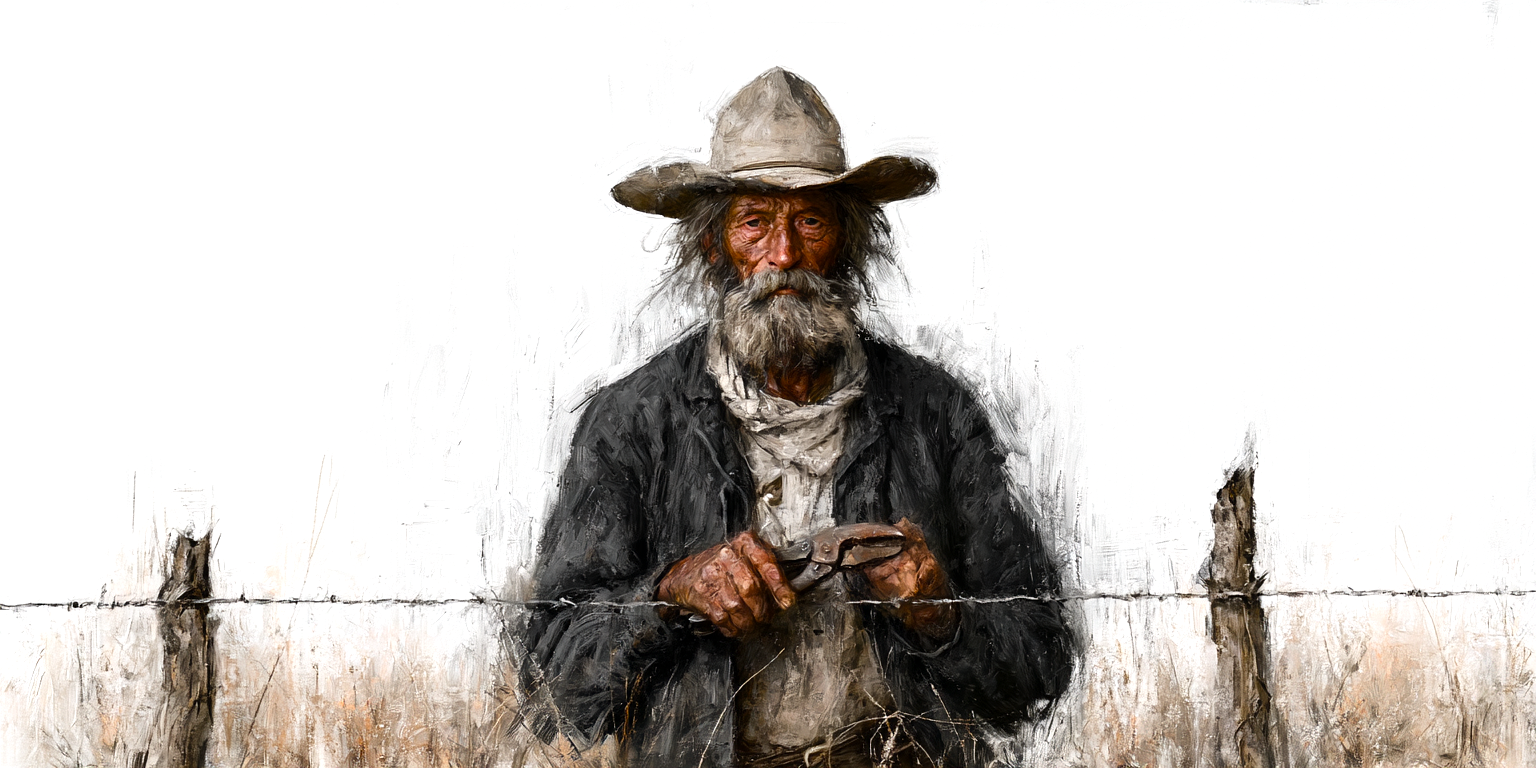
Image: The Editor (AI-assisted digital image) by O:JA&L staff creative. 2026. Public domain via Midjourney AI.
OJAL Art Incorporated, publishing since 2017 as OPEN: Journal of Arts & Letters (O:JA&L) and its imprints Buttonhook Press, HOT BUTTON PRESS Contemporary Issues, and HIGH BUTTON PRESS Contemporary Art, supports writers and artists worldwide.

The O:JA&L Free Presses Masters Series
The O:JA&L Free Presses Masters Series (from OPEN: Journal of Arts & Letters) gathers acclaimed writers for concise, downloadable chapbooks that pair fresh work with candid reflections on craft. Each installment—often framed by an interview with an associate editor—opens a window onto how masters of poetry, prose poetry, flash fiction, and related hybrid forms build voice, compression, and surprise. Designed as a reader’s invitation and a writer’s toolbox, the series celebrates literary art that moves fast, cuts deep, and lingers long after the last line.
Click on the titles below to explore or download the free PDF chapbooks.
Prose Poetry and Flash Discourse
The Buttonhook Press Masters Series: Brian Clements on Prose Poetry
With an Interview by Associate Editor Pamelyn Casto
The Buttonhook Press Masters Series: Mark Budman on Flash Discourse
With an Interview by Associate Editor Pamelyn Casto
The Buttonhook Press Masters Series: Ray Gonzalez on Prose Poetry
With an Interview by Associate Editor Pamelyn Casto
The Buttonhook Press Master Series: Michael Martone on Flash Fiction
With an Interview by Associate Editor Pamelyn Casto
The Buttonhook Press Master Series: Roberta Allen on Flash Fiction
With an Interview by Associate Editor Pamelyn Casto
The Buttonhook Press Master Series: Peter Conners on Flash Fiction
With an Interview by Associate Editor Pamelyn Casto
The Buttonhook Press Masters Series: Maxine Chernoff on Prose Poetry
With an Interview by Associate Editor Pamelyn Casto
The Buttonhook Press Masters Series: Pedro Ponce on Flash Fiction
With an Interview by Associate Editor Pamelyn Casto
The Buttonhook Press Masters Series: Kent Dixon on Flash Fiction & Nonfiction
With an interview by Associate Editor Pamelyn Casto
MIixed Forms: Haibun, Haiga, & Tanka Prose
The Buttonhook Press Masters Series: Roberta Beary on Haibun
With an interview by Associate Editor Pamelyn Casto
Experimental Discourse
The Buttonhook Press Masters Series: Jim Meirose on Experimental Discourse (XP)
With an interview by Associate Editor Warwick Newnham
Poetry: All forms & styles
The Buttonhook Press Masters Series: Poetry from Bruce McRae
With an Interview by Associate Editor Jeff Streeby
The Buttonhook Press Masters Series: Poetry from Richard Widerkehr
With an Interview by Associate Editor Jeff Streeby
The Dally Post Press Masters Series: Cowboy Poetry from Rod Miller
With an Interview by Associate Editor Jeff Streeby
More titles in press

