

HAL: Heuristic Analysis Library
Issues of Contemporary Aesthetics
NO EASY TRAIL
A review of THE HORSE KNOWS THE WAY HOME: Poems by Ann Fulleros
Click on the title NO EASY TRAIL to download this free PDF pamphlet.
O:JA&L DALLY POST PRESS CHAPBOOK SERIES.
Publisher’s official page for the Ann Fulleros chapbook.
Follow this link to explore or download the free PDF chapbook.
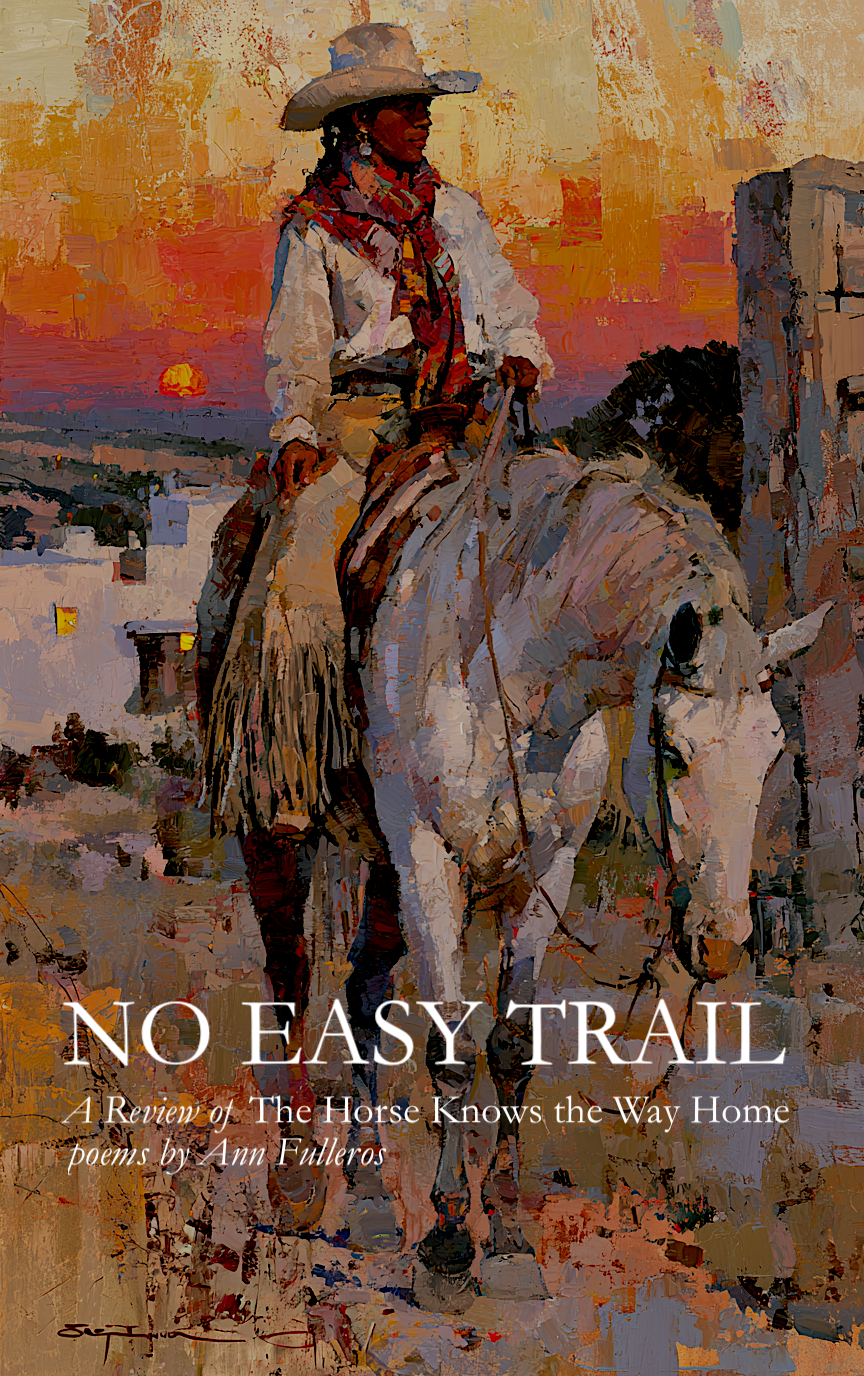
Title of the Collection: The Horse Knows the Way Home: Poems
Author/Poet: Ann Fulleros, a writer and educator whose work addresses love, loss,
. faith, memory, and resilience; her earlier book is Every Bit of My Heart (2021).
Publisher & Date: Dally Post Press, an imprint of OPEN: Journal of Arts & Letters, 2026.
Page Count: 20 poems, arranged in four sections across 61 pages
. including front and back matter.
Format Reviewed: Digital chapbook manuscript.
ISBN: Not listed in the reviewed copy.
IN ANN FULLEROS’S THE HORSE KNOWS THE WAY HOME, the horse is more than companion or emblem: it is a steady intelligence that carries a wounded speaker from abandonment toward self-possession. The chapbook works within cowboy poetry’s plainspoken, landscape-centered tradition while shifting its center of gravity toward a woman’s emotional survival. Ranch labor, weather, roads, fences, and horses become a contemporary vocabulary for grief, faith, and independence. Accessible and carefully sequenced, the collection uses spare free verse and recurring Western motifs to create a persuasive arc from loss to reclamation. Its strongest poems convert familiar cowboy imagery into precise emotional architecture, even if its repeated affirmational turns occasionally make its discoveries more explicit than they need to be.
The collection’s four five-poem sections—“Saddle,” “Weather,” “The Long Road,” and “Home”—give the book the shape of a journey. The sequence moves from learning the terms of attachment, through exposure and testing, into departure, endurance, and return. Early poems distinguish speech from dependable action and confront the persistence of absence; the middle sections transform storm and travel into tests of agency; and the final section reframes home as continuity with the self rather than dependence on another person. Short stanzas, isolated sentences, and recurring departures make the book move at a deliberate walking pace. That repetition supplies ritual coherence, although several poems arrive at closely related lessons, slightly reducing surprise in the middle of the collection.
Fulleros writes in unmetered free verse, relying on compact stanzas, direct address, catalogues, parallel syntax, and parable-like turns. Many poems begin with a concrete ranch image, widen into reflection, and end with a distilled statement. Cadence matters more than fixed meter. Repeated constructions such as “I learned,” “I stopped asking,” and “The road did not ask” create a spoken, incantatory music well suited to oral performance, while hard stresses in words such as “boots,” “dust,” “gate,” and “road” give the poems tactile weight. Brief lines isolate actions and nouns, slowing the reader and lending ordinary gestures moral consequence. White space often becomes a pause before recognition; at its best, the break allows an image to carry the insight before the poem explains it.
The diction throughout is colloquial, uncluttered, and earnest. The dominant tone is elegiac but not defeated: the speaker repeatedly turns sorrow toward practical wisdom without abandoning vulnerability. Horses, dust, roads, gates, fences, storms, barns, coffee, leather, and morning light recur as both physical details and emotional coordinates, rendering interior change through work, weather, and movement. In “The Empty Stall,” for example, absence becomes architecture. The barn’s vacancy is not merely evidence of loss but proof that something once lived there and that a heart can be built with room for departure. In the title poem, the horse’s remembered route converts instinct into a model of recovery: when conscious direction fails, embodied knowledge still leads the speaker home.
The collection’s central concerns—abandonment, grief, emotional self-reliance, faith without certainty, memory, and survival—are held together by the patient labor of rebuilding a life. Fulleros departs most meaningfully from conventional Western mythology in her treatment of courage. Rather than staging the West as a theater of masculine conquest, she makes it the setting for a woman’s self-recovery. Bravery appears not as domination or gunplay but as opening a gate, mending a fence, standing through rain, mounting again, and refusing to surrender one’s name. Healing, accordingly, is less a dramatic revelation than a practice of continuing: attending to animals, weather, prayer, work, and one’s own durable body until home becomes an inward relation rather than a person who may leave.
Several poems demonstrate how effectively Fulleros joins ranch detail to emotional argument. “The Woman at the Hitching Post” contrasts a man who speaks of love with one who unsaddles his horse, making care for the animal the measure of credible devotion. The poem’s judgment is simple but resonant: language promises, while attention proves. “The Empty Stall” makes its decisive turn in the sentence “That is architecture,” transforming vacancy from failure into a necessary capacity for change. “What Survives Winter” locates resilience in unnoticed routines—rising, washing, making coffee, writing, praying—while its buried roots figure recovery before visible proof. The title poem gathers the collection’s motifs into its fullest recognition: the horse remembers the path, but the speaker discovers that home is “the woman who stayed with herself.”
The chapbook’s principal strength is the consistency of its governing metaphor. Clean diction, lucid sequencing, memorable closing turns, and the fusion of ranch detail with emotional insight make the poems immediately legible and particularly effective when read aloud. The same clarity can also become a limitation. The repeated pattern of concrete image followed by explicit lesson grows predictable, and several aphoristic formulations approach familiar inspirational language. The collection would gain texture from more tonal variation, greater narrative specificity, and moments in which ambiguity is permitted to remain unresolved. Even so, its cumulative effect is consoling rather than sentimental. Survival emerges as bodily, repetitive, and ordinary, while faith appears not as certainty but as the willingness to keep moving without complete knowledge.
Ultimately, The Horse Knows the Way Home gives cowboy poetry an intimate, restorative emphasis. The open range becomes a landscape in which a woman learns that endurance is not waiting for someone’s return but remaining faithful to her own life. Fulleros’s humane steadiness, memorable Western imagery, and disciplined emotional arc outweigh the occasional overstatement, making this a coherent and affecting chapbook. It is recommended for publication and for readers of cowboy poetry, accessible contemporary free verse, women-centered Western writing, spiritual poetry, and work concerned with grief, resilience, and recovery. The collection’s most enduring achievement is its redefinition of home: not a porch light tended by another, but the self that survives the storm and continues toward the light.
ABOUT ANN FULLEROS:
ANN FULLEROS is a Filipina writer and educator whose work explores love, loss, faith, memory, and the quiet work of becoming whole again. She is the author of Every Bit of My Heart (2021) and continues to write poetry and creative nonfiction drawn from personal experience and observation. Her writing often centers on emotional truth, resilience, and the small moments through which people find their way home.
Image: Home Late (SI-assisted digital image) by O:JA&L staff creative. 2026. Public domain via Midjourney AI.
This project was made possible, in part, through support from
Richard Stimac and his new book BLOOD, WATER, AND STONE
available now from Spartan Press.

OJAL Art Incorporated, publishing since 2017 as OPEN: Journal of Arts & Letters (O:JA&L) and its associated imprints, supports writers and artists worldwide.
The O:JA&L Free Presses Masters Series
The O:JA&L Free Presses Masters Series (from OPEN: Journal of Arts & Letters) gathers acclaimed writers for concise, downloadable chapbooks that pair fresh work with candid reflections on craft. Each installment—often framed by an interview with an associate editor—opens a window onto how masters of poetry, prose poetry, flash fiction, and related hybrid forms build voice, compression, and surprise. Designed as a reader’s invitation and a writer’s toolbox, the series celebrates literary art that moves fast, cuts deep, and lingers long after the last line.
Click on the titles below to explore or download the free PDF chapbooks.
Prose Poetry and Flash Discourse
The Buttonhook Press Masters Series:
Brian Clements on Prose Poetry
With an Interview by Associate Editor Pamelyn Casto
The Buttonhook Press Masters Series:
Mark Budman on Flash Fiction & Nonfiction
With an Interview by Associate Editor Pamelyn Casto
The Buttonhook Press Masters Series:
Ray Gonzalez on Prose Poetry
With an Interview by Associate Editor Pamelyn Casto
The Buttonhook Press Master Series:
Michael Martone on Flash Fiction
With an Interview by Associate Editor Pamelyn Casto
The Buttonhook Press Master Series:
Roberta Allen on Flash Fiction
With an Interview by Associate Editor Pamelyn Casto
The Buttonhook Press Master Series:
Peter Conners on Flash Fiction
With an Interview by Associate Editor Pamelyn Casto
The Buttonhook Press Masters Series:
Maxine Chernoff on Prose Poetry
With an Interview by Associate Editor Pamelyn Casto
The Buttonhook Press Masters Series:
Pedro Ponce on Flash Fiction
With an Interview by Associate Editor Pamelyn Casto
The Buttonhook Press Masters Series:
Kent Dixon on Flash Fiction & Nonfiction
With an interview by Associate Editor Pamelyn Casto
The Buttonhook Press Masters Series:
Tom Hazuka on Flash Fiction
With an interview by Associate Editor Pamelyn Casto
MIixed Forms: Haibun, Haiga, & Tanka Prose
The Buttonhook Press Masters Series:
Roberta Beary on Haibun
With an interview by Associate Editor Pamelyn Casto
Experimental Discourse
The Buttonhook Press Masters Series:
Jim Meirose on Experimental Discourse
With an interview by Associate Editor Warwick Newnham
Poetry: All forms & styles
The Buttonhook Press Masters Series:
Poetry from Bruce McRae
With an Interview by Associate Editor Jeff Streeby
The Buttonhook Press Masters Series:
Poetry from Richard Widerkehr
With an Interview by Associate Editor Jeff Streeby
The Dally Post Press Masters Series:
Rod Miller on Cowboy Poetry
With an Interview by Associate Editor Jeff Streeby
More titles in press

