

The O:JA&L Masters Series
POETRY: All forms & styles
An Essay on Craft
Richard Widerkehr
What on Earth?
Click HERE to explore or download Richard Widerkehr’s free PDF chapbook WHAT ON EARTH?
Short lyric poems can hold an entire world in a few lines: a moment caught in motion, a story compressed, or an insight earned at the edge of experience. In their best versions, everyday speech rubs against metaphor until language begins to sing, and the reader feels time slow, as if attention itself were a kind of gravity. This essay explores how poets achieve that intensity through image, sound, and craft. By looking closely at work by Patricia Hooper, Joseph Stroud, and Wisława Szymborska, Widerkehr traces how detail and diction turn observation into revelation.
I’D LIKE TO BEGIN this talk with a few examples of short lyric poems. Sometimes, these are captured moments, sometimes compressed short stories, maybe with the speaker’s hard-won insight near the end. Often there is a tension between plain speech and metaphor that lifts the language toward song. Time can seem to slow down for the reader, as when light approaches a very large object, such as a black hole, physicists tell us.
Let’s look at a poem by Patricia Hooper from her fifth book, A Necessary Persistence.
SIGHTINGS
The world leafs out again, the willow first
and then the river birches near the road
we’re driving down, you in your car seat watching,
for hawks or smaller birds returning home.
Two years have passed since you could walk or stand
alone. The winter-damaged fields are sown,
and there, along the ridge, unraveling,
spirals of songbirds, drifts of dogwood trees,
restored to blossom, beauty that breaks the heart.
And you whose spinal cord could not be healed:
you’re lowering the window, looking up
at miles of wings, your face alive with joy.
As we’re drawn by details into this bird-watching trip in spring, the language is quiet, not calling attention to itself. Then those winter-damaged fields that are sown make their entrance. Good word, sown. The “you” is the speaker’s paralyzed grandson. Hooper has raised the stakes, and we feel her urgency, released from spirals of songbirds, drifts of dogwood trees… this injury that could not be healed… heart-breaking beauty…miles of wings, your face alive with joy. Clear images, strong feeling—a grandson’s wonder, the speaker’s joy and gratitude—this poem is a gift to the reader.
Now let’s look at a less formal kind of poem by Joseph Stroud from his book of collected poems, Of This World.
THE PERFECTION OF CRAFT
The great blue heron stalks among reeds,
stops—alert—then stabs its beak, flings
into the air a roiling snake, and catches it,
tosses it again, the snake not knowing
what on earth, caught once more, head first,
still alive, slithering down the herons’s throat.
We see the heron catch a snake, toss it in the air, catch and toss again, as if this were a game, so the serpent goes down “alive, slithering into the heron’s throat.” What an image! But the poem is about craft. Perhaps, the poet is like a heron, and the poem is the snake, not knowing what on earth, says our speaker, all at once in the point of view of the snake.
The ideas and shifting point of view are complex, the images stark. Notice Stroud’s active verbs—stabs, flings, catches, tosses. “Stalks” is more accurate than “walks.” Also, more vivid. A “roiling snake in the air,” suggests turmoil; it’s a better word than “writhing” here. Maybe the word “coils” is in the back of our minds. And look at Stroud’s switch from the fancy word “roiling” to plain speech, “what on earth.” Yes, what on earth?
I should tell you I am a musician and a singer. Sometimes, when a certain word in my poem doesn’t sound right, I search, not for a synonym, but a word that rhymes or is a half-rhyme. For me, sound is part of the energy that drives the poem, almost as if our lines were a force field. Sometimes, this can lead me to a surprising word or image. Another way of getting back into a poem that isn’t finished is to re-type the poem, changing line endings and/or stanza breaks, or changing the speaker from “I” to “you” or “he.”
Sometimes, I write in the voice of a persona who is not myself, as in my poem, “Sympathy for the Scarecrow.” Sometimes, paradoxically, the invented speaker can free us to take more risks, go into subject matter that may be hard to touch, as in, Szymborska’s poem, “Lot’s Wife, ” which opens like this:
“They say I looked back out of curiosity. But I could have had other reasons. I looked back mourning my silver bowl. Carelessly, while tying my sandal strap. So, I wouldn’t have to keep staring at the righteous nape of my husband Lot’s neck.”
I’ve left out the line breaks on purpose. See how prosy this is, how plain the language, how believable Lot’s wife is, how we get clear images and then a sarcastic attitude toward her husband. It is what I call a conversation poem, mixing images and plain speech.
Nearing the end of this talk, I recall when I was nineteen years old, standing with my girlfriend on the pedestrian walkway of the Ambassador Bridge that goes from Detroit to Windsor, Canada. “A geometer’s dead forest,” I would call the bridge’s towers and cables in my poem. As semi-trucks shifted gears and climbed toward us, the bridge began to shake. I don’t recall thinking, What on earth? But yes, what on earth!
Though I grew up in big cities—New York, Detroit—for almost forty years I have lived in the “county,” in a small red house on a chip-seal road in northwest Washington. A “necessary persistence” keeps us going.
About the writer:
Richard Widerkehr’s fifth book of poems, Missing The Owl, is available from Shanti Arts Publications, as is his previous book, Night Journey. He has also published three chapbooks and one novel, Sedimental Journey (Tarragon Books). He received his M.A. from Columbia’s University, which he attended on a Woodrow Wilson Fellowship. His work has appeared in O:JA&L, Writer’s Almanac, Verse Daily, Atlanta Review, and many others. He won two Hopwood first prizes for poetry at the University of Michigan, three Sue C. Boynton awards, three prizes at The Bridge, and first prize for a short story at the Pacific Northwest Writers Conference. He has worked as a teacher in the Upward Bound Program at Western Washington University and, later, as a case manager with the mentally ill.
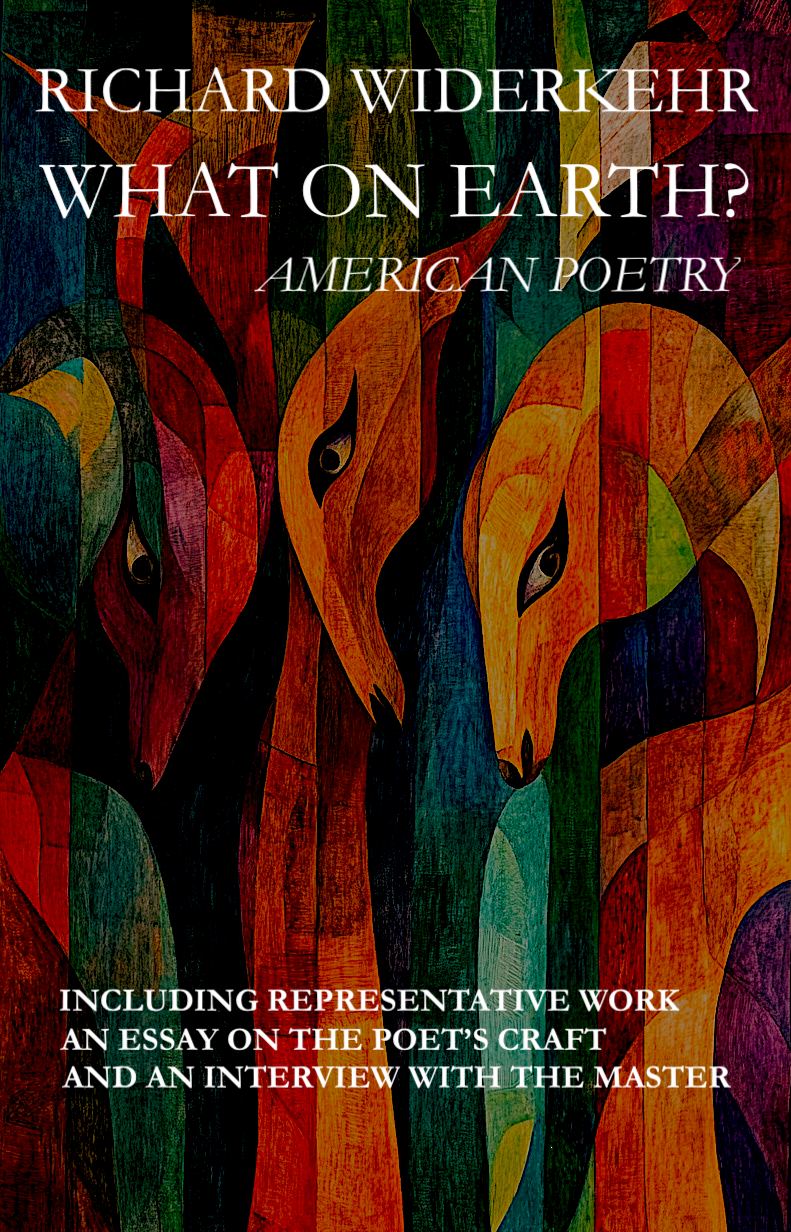
Image: Theriomorphs (AI-assisted digital image) by O:JA&L staff creative. 2026. Public domain via Midjourney AI.
Also available from Richard Widerkehr at O:JA&L:
OJAL Art Incorporated, publishing since 2017 as OPEN: Journal of Arts & Letters (O:JA&L) and its imprints Buttonhook Press, HOT BUTTON PRESS Contemporary Issues, and HIGH BUTTON PRESS Contemporary Art, supports writers and artists worldwide.
O:JA&L’S BUTTONHOOK PRESS MASTERS SERIES
Click on the titles below to explore or download the free PDF chapbooks in the O:JA&L Masters Series.
The Buttonhook Press Masters Series: Brian Clements on Prose Poetry
With an Interview by Associate Editor Pamelyn Casto
The Buttonhook Press Masters Series: Mark Budman on Flash Discourse
With an Interview by Associate Editor Pamelyn Casto
The Buttonhook Press Masters Series: Ray Gonzalez on Prose Poetry
With an Interview by Associate Editor Pamelyn Casto
The Buttonhook Press Master Series: Michael Martone on Flash Fiction
With an Interview by Associate Editor Pamelyn Casto
The Buttonhook Press Master Series: Roberta Allen on Flash Fiction
With an Interview by Associate Editor Pamelyn Casto
The Buttonhook Press Master Series: Peter Conners on Flash Fiction
With an Interview by Associate Editor Pamelyn Casto
The Buttonhook Press Masters Series: Maxine Chernoff on Prose Poetry
With an Interview by Associate Editor Pamelyn Casto
The Buttonhook Press Masters Series: Pedro Ponce on Flash Fiction
With an Interview by Associate Editor Pamelyn Casto
The Buttonhook Press Masters Series: Tom Hazuka on Flash Fiction
With an interview by Associate Editor Pamelyn Casto
The Buttonhook Press Masters Series: Kent Dixon on Flash Fiction & Nonfiction
With an interview by Associate Editor Pamelyn Casto
MORE TITLES IN PRESS

