

Explore O:JA&L’s Buttonhook Press offerings on Amazon.
Subscribe to the O:JA&L YouTube channel.
Become an O:JA&L Member through Patreon.
Support Pamelyn Casto’s text for writers: Flash Fiction: Alive in the Flicker
Support O:JA&L’s free presses.
Travis Flatt
Two Flash Stories
Death!
I connect with my stepson through riposte and parry, appel and bind. He’s twelve. We assault along our rain blackened driveway, tapping and sliding duct tape wrapped blades. I built the swords from PVC pipe and insulation foam, desperate to show I can still maneuver my middle-aged body, how I’m not hopelessly brittle, clumsy, silenced. The language of sports has failed us. The kid can throw a football over the house; I never learned how to spin spirals, sling hook shots, crack a tee. In college, I studied fencing and stage combat, the closest thing to athletics I know. Whenever he’s losing a match, he gets frustrated, hurls his sword end over end and shouts, “Death!” With my padded foil, I smack the weapon from the air, advance to slay him. He giggles and turns tail. The rain decides it’s not quite finished. My wife steps out on the porch, asks us to come in. Were we playing football or baseball, I’d be thankful for the rescue, but my son shouts, “Ten more minutes,” which, of course, is an arbitrary amount and only means we’ve reached a breakthrough. I shoot a glance at my wife, and she nods, smiling. I flush. The kid stabs me in the back and roars laughter. I grasp him in a headlock. We tumble to the grass.
We untangle, climb up, and limp inside, muddy. In the foyer, a minefield of the legos he refuses to pick up, he tells me I’m a ghost, that I’m dead, that he killed me. It’s the longest conversation we’ve had in days. So I eerie up my voice, say, “Ooooo, pick up some of this shit, okay?” and hear him giggling as I haunt down the hall for a hot shower and the beckoning bright tunnel of a nap.
A Flower, a Pistol, and a Music Box
Malone plucks a pink wildflower from the roadside, then a second—one for her, one to brighten his cell—and coughs blood into his handkerchief.
Nearby, Alexandre sits on the oak tree they fell across the road and gazes down the barrel of his pistol. “I get this funny feeling,” he says, “like the thing reloads itself.” He shakes his head and aims the empty pistol off into the blue sky. “How long, you figure?”
Malone says not to worry with the pistol, they’re getting old, that he gets funny feelings, too. There’s no need to answer how long: the carriage appears, crunching slowly around the bend and busting up dust, sending squirrels running confused and excited along the branches. Both men step into the road. Malone pockets the flowers, checks over his shoulder that the music box sits where he tucked it, half under the oak. All’s ready and feels right.
The carriage, driven by the Duke of Essex, a rich man too cheap to hire his own driver, slows to a stop about twenty meters before Malone and Alexandre, close enough to see the pistol, too late. There’s no room to turn around.
“Sorry,” Malone calls out, “to inconvenience you. We’ll make this brief.”
The Duke of Essex keeps a pistol in the carriage, along with his wife, the Duchess, but neither do him any good now, he thinks. He curses and raises his gnarled, arthritic hands. “I don’t carry much on me.” He tugs off his rings, unclasps his necklace.
While Alexandre trains the pistol on the Duke, Malone opens the carriage door, bows deeply to the duchess, who is as young and pretty as they say, and offers a hand for her to step down onto the road.
She smiles, takes the offer, and joins him. He tucks the pink wildflower behind her ear; it compliments her eggshell dress. He tells her so and she blushes.
The music box tinkles out a strain of “Sarabande,” which is accompanied pleasantly by the birdsong. She’s a so-so dancer, Malone thinks, badly taught but naturally graceful.
The Duke, who’s stood quietly aside, loses his temper and rushes forward, clawing for Malone’s back.
The pistol is, in fact, loaded.
The shot rings out through the forest, silencing the birdsong. The Duchess turns whiter than her dress, too shocked to scream.
“Shit,” says Alexandre, pistol trembling in his hand.
Malone says nothing.
They run for their horses, who they’ve tied to a shepherd’s fence in a field a half mile away.
No horses wait. They yanked free at the sound of the gunshot. Their tracks lead in opposite directions.
“Shit,” says Alexandre, broken slat in his hand.
Malone coughs pink phlegm into his handkerchief.
The day’s all premonition.
A dozen young soldiers on patrol from London first meet a madly rushing horse, then a shocked young woman sitting dazed beside a gunshot old man, and so on.
###
Alexandre never knows when to shut up and is hung from a tree where they’re scooped up, dies wild-eyed and rabid with curses, embarrassing Malone, whom the soldiers escort back to London, as pleases him, to await his morning execution in a solitary cell. He tidies up the cell, decorates it with his flower, setting it in his water cup which he rests on the windowsill, and lays the music box at the foot of the cot, satisfied.
He says good evening to his guard, insists the man not delay attending his toothache—such things shouldn’t be overlooked.
The guard says that’s wise advice. He’s noticed Malone’s coughing jags and offers warmer water, he asks, “Are you alright?”
“Probably. Except the dying.” Malone says.
“Better you than me,” says the guard.
Malone agrees. He kneels and says his prayers, including the guard (and his toothache) and that idiot Alexandre. He falls asleep to the sound of rat scurry and “Sarabande” and dreams of his mother—this is less pleasing, but what can you do?—and a young woman with a pink flower in her hair.
###
Considering the short notice, the morning draws a respectable turnout. Malone bows to his guests. He recognizes several pretty faces in the crowd. Although he thinks it somehow ungentlemanly to rank or play favorites, Malone does favor the better dancers, and he tosses out some winks. And yet, there’s something about the Duchess of Essex, who’s made the trip, bless her heart, still wearing the pink flower.
He’s mortified to feel blood on his lips, wishes his hands were free to wipe them clean.
Malone’s never given much thought to this next part, and is glad for that. What would be the point? As they lead him to the platform, he’s disappointed to discover his heart racing. A priest drones on and the hangman worries with something mismeasured, allowing Malone a moment to reflect and study the sky and crowd.
To think there awaits some golden, cloudbound city he finds childish. Likewise rivers of flame. What he imagines is a grayish nothing, a nothing soup, forever stirred, which sounds just fine to him.
He’d ask they play the music box, but worries that would sound childish, and gives the Duchess a ruby-lipped smile. The hangman approaches with a burlap bag. Malone clears his salty throat and calls out to the crowd: “A farmer, going across his grounds, sees a young couple at his fence…”
The hangman yanks the sack over Malone’s head to boos and groans. Malone is hauled up the last step, smiling to himself, carrying away the punchline.
About the Writer:
Travis Flatt (he/him) is an epileptic teacher and actor living in Cookeville, Tennessee. His stories appear in Fractured Lit, Gone Lawn, JMWW, Flash Frog, HAD, and other places. He is a Best Small Fictions nominee, was long listed for the Wigleaf Top 50, and is a finalist in the Smokelong Quarterly Summer’s Flash Fiction contest. He enjoys theater, dogs, and theatrical dogs.
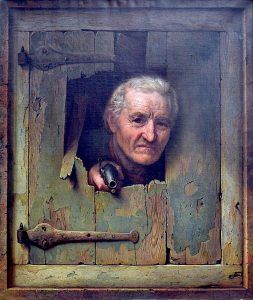
Image: Man with a Pistol by Johannes Helder ().
OJAL Art Incorporated, publishing since 2017 as OPEN: Journal of Arts & Letters (O:JA&L) and its imprints Buttonhook Press, HOT BUTTON PRESS Contemporary Issues, and HIGH BUTTON PRESS Contemporary Art, supports writers and artists worldwide.
FOLLOW O:JA&L on  .
.

