

O:JA&L Prose Discourse: Nonfiction
Memoir/Personal Essay
Jonathan Mark
WHY ARE YOU CRYING?
THE QUESTION
The fan hums behind us, chopping the silence into pieces.
The hospital room smells of glass cleaner, piss.
On the small bedside cabinet sit paper cups, soaked with stale water.
Rain presses against the glass behind the olive curtain, tapping a soft and steady rhythm.
His lips tremble. Swollen fingers rest in his lap.
I sit closest to the door. My mother sits to my right, silent for seconds that stretch.
She leans toward him, speaking with soft measure.
“Why are you crying?”
He looks at her, then at me. He says nothing. The tears come anyway.
I lower my eyes to the floor and count the tiles. I don’t want to see him like this.
I watch the lump in his throat crawl to his jaw. His eyes, glassy and pink, look away from us.
No one speaks.
THE DIAGNOSIS
The practitioner’s voice is softer than her youth. Soft, not kind.
She asks my grandfather to draw a clock.
He grips the pen with distrust and writes:
2, 7, 6, 8, 3, 1.
The numbers drift. Time slips sideways.
I remember those numbers, his voice repeating them on voicemail.
“2 7 6 8 3 1 3… we’re not home right now.”
More questions follow. Patterns. Words. Problem-solving.
She asks him the date: May 1st, 2023.
He says June 4th, 1941. His birthday.
“Johnny,” she says.
“Your wife had some concerns. Your test scores do not pass. These scores indicate
symptoms of dementia.”
The word lands flat. Dementia. Rehearsed, without weight.
He doesn’t care about the diagnosis. He’s furious that he failed. That’s what wounds him most.
“Look, I was a headmaster. Back in Essequibo. Ask any one of them. I know what
I’m talking about. Girl, I never failed a test in my life. Nonsense. Jon’tan, let’s go. Let’s go before
I really burst my veins here.”
He leaves me to collect the resources, the contacts, the next steps.
And all I see is hatred in his eyes.
The silence that follows fills the car with heat as he begins to burn.
His hands shake. Sweat drips down his neck. His shirt clings to him, damp with frustration.
“A complete jackass. Any of those bitches. I could teach them anything. Maths.
English. History. Literature. Etiquette. Stupid fools. Any one of them could never do what
I did. Don’t you ever bring me back there. Y’undastand?”
His voice quakes. He rubs his eyes. Stares out the window.
“Fucking ignoramus. That bitch. Ugly, stupid dog.”
Later, I tell my grandmother about the test. About his rage. Last month, she called me crying.
At night, he goes downstairs to use the washroom. When he’s done, he panics. He screams in
confusion because he can’t find the bedroom. She doesn’t know how to help him anymore.
THE TEACHER
He walks to school before sunrise in a pressed shirt.
A bag with his lunch, chalk, paper, and always a slate.
He teaches in villages across Wakenaam, a small island cradled by the Essequibo River.
Villages like Arthurville, Ridge, Sans Souci. Places too small for maps.
The children of the island love him.
Students sometimes follow him home after lessons, asking for more.
They laugh as he teaches them limericks and recites the great poets with exaggerated voracity.
It’s how he teaches them to code-switch, out of Guyanese patois and into the adopted
British inflection of the country’s intellectuals. He whispers to the older students that while
socialism promises wellbeing for all, corruption belongs to men, not ideas.
Many come from homes crushed by the national curse of alcoholism.
He fights for them because he once fought for himself, against a father who wanted him to farm
instead of teach.
Knowledge, he believes, is the only freedom.
They say his voice is ‘clean’, meaning bold and precise.
He teaches arithmetic through rhythm and laughter.
He makes a girl recite her timetables while balancing fruit on her head.
At night, he writes letters to Georgetown demanding books.
He confronts teachers who bully children or use the cane too freely. He hates laziness.
He rises from teacher to headmaster.
As a child, I think headmaster means king.
I never met that version of him. When I visit Guyana, his students all
have their own stories of Teacher Johnny. But that was then, on an island where he had a voice.
In Canada, his credentials and his Oxford and Cambridge exam results mean nothing.
His history, erased. Teaching becomes my exclusive inheritance at home.
Books in every subject. Kitchen table lectures. Homework in exercise books. Tests on weekends.
I didn’t realize moving to Canada meant he’d have to give up not just a career, but his identity.
THE ARREST
December 14. A week and a half before Christmas.
A text from my mom:
“Jon, I heard Papa is in the hospital. The ambulance took him during the week.”
Then one from my aunt:
“Hi Jonathan. Your grandfather is in the hospital.”
My first uncle said he was being admitted for tests.
The truth: he’d been hospitalized since November 27th.
Three weeks in a bed, and I was only finding out now.
The days blur.
Work, drive, hospital. South Elevator. Sixth floor. J Wing.
$22.50 for parking.
Cold apple juice for him. Coffee for me.
“Brilliant,” he says, every time he takes the first sip.
I ask the nurses questions. They glance sideways and whisper.
“You should ask your family.”
My family has no answers.
I keep my face stiff. I wear sunglasses in the elevator.
I cry in the car on the way home.
He spends Christmas and New Year’s in the unit. My uncle says it’s his worst Christmas ever.
Mine is worse. He waited three weeks to tell us.
On one of the last days before his transfer to another unit, I ask a nurse,
“How did he get here?”
She hesitates.
“Are you sure you want to know?”
Then: he was brought in by police.
Not the first time.
Months earlier, the Alzheimer’s Society had scheduled a home visit.
He refused. Argued.
His blood pressure spiked.
Paramedics came. He refused them too.
His file was flagged, so they called the police.
I didn’t know any of this when I first saw him that day.
He was on a stretcher in the hallway. No socks. No glasses.
The light made his skin paper-thin. His arms shook.
“Jon’tan, me sorry you have to see me here boy,” he whispered.
They discharged him that same day. I took him back to his home. He spoke little that day.
I didn’t know I’d done the “wrong” thing.
Later, I learned some family members had hoped that hospitalization would be permanent.
What I didn’t know at the time was that they’d already begun laying the groundwork
for legal intervention. They blamed me for taking him home that day, even though the doctor
had discharged him. The hospital had no idea what was happening behind the scenes.
By December, the tone had shifted. This time, it wasn’t just nurses in the hallway.
Someone stood at his door. I was no longer just a grandson. I was a visitor.
The hallway feels endless.
Posters of staff dressed as elves. A Christmas tree. Hand-washing signs taped to the wall.
A security guard stands outside his room.
“I’m his grandson.”
“Okay. But no closing door fully, alright? Your Grampa. Aggression. Hospital rules.”
He’s asleep when I enter, letting out a low, constant sound. It comes from deep in his chest,
closer to humming than moaning.
I place my hand on his chest.
He opens his eyes and weeps. From his gut. Not quiet. Not tears.
The sound breaks me.
“I thought you forgot me,” he says.
“I thought you forgot me…” his voice torn with sorrow.
His words slip under the medication as they drag.
The staff won’t tell me what they’re giving him.
No one can explain what is happening.
He holds my arm. His fingers are ice.
He begs like this almost every visit.
“Look, you and me, we can go. Just take me, nah man. Me cyan’ stay here. Oh Lord,
please let’s go please, please I’m begging. Take me wit’ you.”
But I have no say. No authority. No legal right.
He will never go home again.
He came here without spare clothes. No glasses. Cold and shaking.
He forgets the details, but he remembers the handcuffs. He brings them up often.
“Villains. Dem blasted snakes.
Dey wan’ fuh laugh hee hee hee and lock me up here wit’ nothing.
I have nothing, Jon’tan. Not one red cent.
These are nasty people, me tell yuh fuh troot.
Look me wrists. Two uh dem blasted jackasses came, and look what dey do.
One on one wrist, one on two wrist.
I told the man I was a gentleman. I wouldn’t fight him.
And I coulda give any one ah dem this fist!
Lord, what crime me commit?
Dey put me here fuh dead.
Dem rass devils. This is death. Oh God take me.
And you tellin’ me I cyan’ go back to me own house?
Disgust’n fucking snakes. De skunts a dem.”
He returns to it every visit.
The story shifts. New officers, new details. But the feeling never changes.
His shame stays. His anger lives.
No one tells me the whole story.
And he can’t.
That’s how memory dies.
In fragments.
In rumours.
In half-closed hospital rooms.
THE FAMILY
Our collapse is a slow rot. Garbage piles, the fridge sours, sleep fades.
Now I always expect tears from my mother, while she expects estrangement from
her siblings, silence from her mother.
“I just want him to have peace. I want him to have dignity.”
She wanted to bring him back two years ago, but my grandmother refused.
She still brings it up. I hear the guilt pressing behind her words.
In the car, she talks the whole way through. I don’t interrupt. She has no one else to tell.
My second uncle still tries to make her laugh. His wife calls her to check in.
She panics if we arrive without food and insists on cooking Guyanese dishes every visit.
She wipes his tears as he cries into his plate, reminding him his mother made these same meals:
pepperpot, dhal, cook-up rice, always made with care. The nursing staff often ask what smells
are making their mouths water.
My brother lives inside a quiet, festering anger: at how our family communicates,
or refuses to communicate. At the rumours in the community. The accusations.
They say we manipulated his will, abused him, abandoned the church. The rumors stretch from
relatives to strangers, names I’ve never met but who somehow know my brother’s and mine.
I don’t argue. I stick to what I know is true. Behind the rumors was paperwork. Court affidavits.
Emergency hearings. Power of Attorney declarations we never saw until it was too
late. I don’t care about wills or inheritances. My brother has never laid a hand on him.
We just want our grandfather to live with dignity. He whispers to me with rage in the tones.
“If I see them, Jon, I promise you I will explode.
All you have shown him is love and kindness.
If they care, why is the visitor log empty?”
My brother is angry at me for not saving space for myself, for carrying more than I should.
He’s right. There’s something festering in me too.
But I push it down.
I disappear into the motions.
Wiping his mouth.
Putting on his socks.
Helping him spell out his name, letter by letter.
Guiding the spoon so he can try to feed himself.
Redirecting him from pissing in the sink. Apologizing to the cleaner for the floor.
Brushing his dentures while trying not to gag.
Scraping the shit and dirt from under his fingernails because he can’t wipe himself.
Each action a small rebellion against helplessness.
I play Jim Reeves while I shave him. At home, I memorize the lyrics about life
in Galloway, Texas, a place I’ll never see. Still, I sing. I hum, and I urge him to join me.
He always closes his eyes and taps his foot to every other beat.
I wonder if the music carries him somewhere.
“Do you remember this voice Papa? Gentleman Jim Reeves?”
“Of course! I taught the boy back in Wakenaam. His father used to cut sugar cane.
A respectable individual! Dey called me to the stage for the wedding.
I was master of ceremonies you know? Dey all came and shook my hand and so-so-so.
And I showed all dem how fuh dance. It was perfect.”
I don’t correct him.
There’s someone real and something true in the story he’s trying to find.
And I know Galloway to Georgetown is a flight that never happened.
I put balm on his lips and ask him to smile for a photo.
His mouth tries. His eyes don’t follow.
I send the photo to my aunt. My mother says we’re alike; I only see her once every few years.
I send an update. She doesn’t visit often. I never try to make her feel bad about it.
I know she can’t bear seeing him like this.
Her daughter left a Bible for him. Their belief in God is ferocious.
“Man proposes, but God disposes,” she says often.
I don’t have the heart to tell her I don’t believe anymore.
But her faith lifts me.
Friends ask how I’m doing.
I give short answers, tell a rude joke, buy them a drink, change the subject.
I build new walls around my fragility. I feel guilty when I smile.
“How are you keeping it together?” they ask.
I don’t answer.
My voice has lost its strength. I mumble. Speaking at a normal volume leaves me winded.
I eat too much, then almost nothing for days. I exercise only to force myself to shower.
I walk away if I see a hospital scene on TV.
My father and I only speak to manage bills.
I don’t answer the phone. I memorize the numbers of creditors and send them to voicemail.
I have hundreds of unread messages and emails.
Each morning, I wake at 5:30.
There’s a half-drunk glass of whisky and cold takeout on the table.
I see someone else in the mirror.
Sometimes I wonder if my neighbour heard me crying on the balcony at night.
One Friday in Spring, I skip my usual visit. Say I’ll go the next day.
I go out with friends and I drink them under the table.
While they stumble, I wonder why I can’t feel anything.
In the taxi ride home, a message:
“Jon, your grandfather asked for you.”
I cry the whole way back. Quiet. Breathless.
We each carry a quiet guilt.
For not visiting, or for counting the minutes until we can leave.
For crying in the car, then wiping our faces before the next shift.
THE POLITICIANS
I remember finding the picture before he was hospitalized.
In one of his many photo albums.
A laminated newspaper clipping of Cheddi Jagan. Full-page, tucked between family photos.
Not a shrine. A reminder.
Cheddi Jagan was Guyana’s first democratically elected leader, founder of the PPP.
A soft-spoken Marxist shaped by sugar strikes and British rule.
My grandfather didn’t see him as perfect.
He saw him as principled.
“An incredible man. He had a face full of people.”
He speaks about Cheddi often. Not like a fan. Not like a comrade.
But like someone who had watched a man try to lift a country with ideas that couldn’t float in
deep water. He believes in what Cheddi represents: integrity, intellect, resistance,
the spirit of a just country. But he also warns me:
“Socialism is a fantasy. Man can rot anything.”
And Burnham did.
Forbes Burnham, Jagan’s former rival, took power with his PNC party after a series of
U.S.-backed betrayals and ruled Guyana for two decades as a pseudo-socialist strongman.
He filled the streets with slogans, emptied the shelves, and made obedience the price of survival.
My grandfather never speaks quietly about Burnham.
Not in Guyana. Not in Canada.
His fury crosses borders with him.
I remember his lectures in his living room.
He talks with heat, contempt in his teeth. Pointing his index finger to his palm to
emphasize every point.
“Ruined Guyana? Jon, oh Lord, don’t let me start. That bloody jackass was a criminal.
An international dunce.”
“Old man, stop talk so hard hard already nah man. You give me headache,”
my grandmother interjects.
“Lady, shut yuh damn mout and make yuhself useful.
De gentleman, my grandson here, wan fuh know.”
There was a rule then, unspoken but enforced:
Speak too loud, and they’d move you.
Align with the wrong party, and they’d erase your post.
He speaks of colleagues stripped from the army for their skin colour.
Teachers who supported the opposition, reassigned to far-flung schools.
People whose names were never spoken again.
The ideology is called ‘paramountcy of the party’.
It means Burnham is above the law, and the law is the party.
It means 90-day detentions without trial.
It means ration books, censored textbooks, and silence.
On islands like Wakenaam, silence was survival.
“Bankrupted the nation. A dictator. A murderer. That bastard lucky he dead.
They shoulda beat him and lock he ass up!”
He was never built for silence.
And he can’t fake affection for a leader so opposite to everything he believed.
In 1972, he left for Canada.
He was offered the chance to stay. Within six months, he missed Guyana.
He went back. He chose home.
But home told him: “No vacancy.”
A headmaster with years in education and there was no job for him.
No post. Not on Wakenaam. Nowhere he could reach without crossing water in the dark.
For two years, he sat in silence. Unemployed. Unacknowledged.
It wasn’t an oversight.
It was the quiet punishment for not kneeling.
Eventually, a friend with PNC ties secured him a placement. Away from home.
He left at 4 a.m. He returned after dark.
A headmaster made to feel like a criminal, commuting across water to teach under suspicion.
And he did it. Because it was the only way to survive and feed his children.
“Paramountcy of the Party? Allegiance before merit, obedience before intelligence.”
And it meant something worse: the mass bleeding of Guyana’s intellectuals.
Teachers. Doctors. Engineers.
Those who could think. Who could question. They fled.
They called it a brain drain.
But it wasn’t drainage.
It was a hemorrhage. An exodus.
The country lost the very people who could have built something lasting.
He left again for Canada in 1986, and this time, for good.
But Guyana had long stopped asking him to stay.
He never taught again.
He never spoke much about the logistics. The applications. The betrayals.
The months he waited at home.
But he made sure everyone knew who had stolen his dignity.
Who starved his friends.
Who punished him for being loyal to students, not the flag.
He tells me the regime had no stomach for men who didn’t bend.
And then there was Jonestown. 1978.
Even now, when I tell people my family is from Guyana, they say:
“Oh, right. Jonestown.” That’s what they remember.
Not ration books, or the hours spent in the hot sun waiting for food
Not the teachers reassigned in silence or military women assaulted in the name of progress.
Not the nights my grandfather crossed river water in the dark to stand in a chalk-dusted
wooden room roofed with rusted zinc.
Just Jim Jones. Just death. Just a spectacle imported from somewhere else.
That wasn’t us.
That wasn’t him.
That was Burnham’s shame.
He let a cult leader into the country for flattery, headlines, and bribes in foreign currency.
For the fantasy of being a global revolutionary, even if it meant turning the country
into a stage for someone else’s apocalypse.
He let in a cult.
He drove out a generation.
My grandfather left teaching because the country forgot what a teacher was for.
He left because he couldn’t kneel.
And kneeling became the only way to survive.
And I wonder now:
Did it matter?
Who remembers the men who didn’t bend? Maybe only their grandchildren,
living in the long shadow of strength.
THE LAND OF MANY WATERS
The first time I went to Guyana, I was three.
I went with my grandfather.
I don’t remember the plane, or the airport, or the amount of people who carried me in wonder.
“An’ who dis little pikney from Canada? Jon’tan? Eh eh, a Bible name?”
Heat, thick and unmoving. Light stinging my eyes.
I remember feeling like everything was happening too fast, and that I was always behind it.
Every time I go back, I try.
I wear the right clothes.
I walk the way I’ve seen others walk. Loose, slow, but never careless.
I say the words and the sayings I’ve memorized.
I can match and best their consumption.
I try to laugh like I belong.
But they always know.
My tongue is the first to betray me.
Even when I say “Wakenaam,” it sounds like I’m borrowing the word. And it’s a Dutch word.
It’s as if the word is waiting for me to give it a name that fits my mouth.
Even when I say “Guyanese,” I can feel the fingers holding air quotes around it.
There’s no word for this in our patois.
This ache. This feeling of being not quite at home in a place that made your parents,
and haunts your blood.
I was born in Canada.
A child of two Guyanese immigrants from different regions.
Different upbringings, different languages of silence.
They met here. I was born here.
First-generation. First rupture.
My grandfather tried to give me Guyana.
In maps. In facts. In lectures.
He taught me the names of the major rivers: Corentyne, Berbice, Demerara,
and the mighty Essequibo.
He told me the history of his British Guiana and his Guyana.
He tested me with chalk and made me recite the major cities: Georgetown, Linden,
New Amsterdam, Anna Regina and Bartica.
He bought me books and told me what to underline.
But there were things he didn’t say.
He didn’t talk about what it meant to grow up with a father who made him work the land
as a child and beat him. He didn’t say much about why he stopped going to church.
He didn’t tell me how he survived being reassigned across islands.
He didn’t want me to know that he often cried on his balcony too. Over the loss of his mother.
He didn’t say what it cost him to come here and never teach again.
So I found Guyana on my own.
I learned the names of the dishes, how to cook them from instinct and smell.
I knew the music. Not just soca, chutney, or calypso, but the old Guyanese ballads with horns
and bent steel percussion.
I think often of a local Guyanese TV show that aired on a small Canadian station.
He recorded every episode onto VHS.
They talked about the news in Guyana, discussed politics, advertised local businesses owned by
Guyanese, and featured dancers and musicians playing typical Guyanese music.
But there was a saxophonist who appeared in a few episodes.
A man who always played an original slow, wandering, aching composition
with a beautiful saxophone melody over programmed drums typical of chutney bands.
Film music from another planet.
Watching him was like dreaming of Coltrane in a sugarcane field.
And it made me wonder:
Was he a Guyanese musician?
Or a Canadian one?
And now, years later, I ask the same thing about myself.
My skin feels too Guyanese for Canadian music.
My music, too Canadian for Guyana.
I’m not sure I fit either.
I remember one morning, sitting beside my grandfather while the show played.
He looked at the same saxophonist on screen, glassy-eyed, nodded.
“Masterful saxophone. Extremely talented.”
Then, without looking at me:
“But I don’t ever want to see you on that show. That program, you go get stuck.
You’re bigger than Guyanese shows.”
I’ve never forgotten that.
What did he mean?
Was he protecting me from something?
Or was he afraid I’d become too Guyanese, whatever that meant?
Even now, when people say I “don’t look” or “don’t sound” Guyanese, part of me is relieved.
And part of me is ashamed.
Sometimes I feel like my parents didn’t want me to be too Guyanese either.
The food, yes. The music, sure.
The family names. The proverbs. The jumbie stories about dead Dutchmen. Yes.
But not the full weight of it.
Not the accent. Not the pain.
Not the smallness they feared being Guyanese came with.
And I’ve carried that shame too.
I get defensive when people accuse me of being too Guyanese. And I get just as defensive
when they say I’m not Guyanese enough.
Once, barreling down the Essequibo in a speedboat, I sat beside an old man.
We exchanged pleasantries. But I didn’t want to let on I was Canadian.
He asked where I was from.
“Guyana.” I said,
He asked if I was in school. I told him I was working.
He smiled. Then said quietly:
“Spider spin web but cowfly fast.”
A proverb that meant: I see you.
I tried to spin something and he flew right through it.
He knew I was lying.
He knew I didn’t belong.
Even though I tried.
Even with other young Guyanese, I navigate the awkwardness of code-switching.
I know enough to start strong, but not enough to finish.
And when I slip back into my Canadian accent, I feel them withdraw.
Like they’ve been tricked. Like I’ve wasted their time.
And with other Canadians, I feel their apprehension. Until I speak.
“You know, you don’t sound like those other ones. You sound Canadian.”
I don’t know if my grandfather wanted to raise me a Guyanese boy.
I believe he wanted to raise me as his kind of boy.
The kind who knows when to be silent.
The kind who knows which books to read.
The kind who knows how to avoid getting trapped.
And still, I love Guyana.
I love it in ways I can’t name.
I love its rivers, its ruins, its rain.
I love how history lives in the mouths of its elders, passed like riddles.
I love the art of George Simon and Oswald Hussein, who create the way our dreams look.
I love the writing of E. R. Braithwaite and the martyr Walter Rodney.
I love hearing old people tell their ghost stories like scripture.
I love how much we’ve forgotten, and how much is still waiting.
I read Blood on the River by Marjoleine Kars and felt like I was discovering
a second Guyana beneath the first.
I realized: the deeper you dig, the more you find.
Guyana isn’t just colonial wreckage and calypso music.
It’s a portal.
It’s something I ache for even as I run from it.
Something I can’t fake.
Something I can’t fully explain.
I’m Canadian. I’m Guyanese. I’m neither. I’m both.
I’m the grandson of a man who laminated a newspaper print of Cheddi Jagan.
I’m the grandson of a man who gave me his library, but not his secrets.
There are things I wish I had asked him.
What scared him?
What haunted him?
What dreams did he bury?
Did he see himself in me?
Did he hope I’d become more like him, or less?
I’ll never know.
And still I carry it.
All of it.
A ghost I can’t help but follow.
THE CROSSING
You do not arrive in Wakenaam by accident.
There is no highway. No causeway uncoiling across river. No jet descending over its edge.
To reach it, you must submit to the Essequibo.
You must rise early and enter the water’s schedule, not your own.
From the Parika stelling, the ferry pushes off with a groan. Its hull smells of diesel and rust.
Deckhands shout over the engine. Vendors retreat down the dock with crates.
The boat settles into the river’s rhythm. Not hurried. Not still.
Or else it’s a speedboat, manned by a bare-chested captain who knows every bend,
the motor whining like a saw as it lifts and slaps the brown water. Silt and leaf-shadow blur.
The river becomes a moving plain, the land melting, remembering how to breathe.
The Essequibo is not a river in the ordinary sense. It is a continent of water.
At its mouth, it spans wider than the Mississippi.
It swells so vast, you lose sight of the far bank before the boat has cleared its berth.
Both sides blur into a dream: mangroves, coconut palms,
little flags of cloth fluttering from poles. Yellow. Saffron. White. Prayers staked in the wind.
Islands drift past: Hogg Island, Leguan Island.
Egrets lift from branches. Fish leap for reasons only they know.
For forty minutes, there is nothing but sky and river and the faint promise
of green on the horizon.
And then, Wakenaam.
Not a city. Not a spectacle.
A breath. A quiet wedge of land, flat and wide, stitched low into the tide.
The piles of the Sans Souci stelling rise first. Greenheart logs darkened by decades of salt,
worn like old teeth. The river does not announce its treasures.
A faded welcome sign. The boat lurches. A rope is thrown.
Wood scrapes wood. You step ashore.
Seventeen and a half square miles, but we round it up to eighteen.
Wakenaam. Its name is older than the nation that holds it.
Dutch, yes: “Wakenaam,” loosely meaning “waiting for a name.”
But the island had names before that. None written in European script.
Names spoken in Lokono. In Kal’ina. In the hush of coastal wind.
The Dutch were the first to claim it in ink. By the 1650s, they had staked out the
Essequibo and its islands for sugar. Timber outposts. Gridded estates.
River logic ruled: drainage, proximity, control.
Wakenaam was long and low and rich with alluvial soil. It was a prize.
By 1750, twenty-nine sugar estates rimmed its edges,
each with its own koker gate, its windmill, its boiling house.
Labour came by force. Three thousand enslaved Africans were whipped and beaten into working
the fields by the century’s end, their lives tallied by their blood in ledgers and erased with lashes.
The interior, less suited to cane, still moved with Amerindian traders.
Cassava. Fish. Hammocks. Seasonal rhythms threading through static bondage.
At Maria’s Pleasure, one of the largest estates, coffee trees curled between rows of cane.
A 600-acre sprawl ringed by canals, governed from a timber house facing the river.
Day-books from 1791 list 105 enslaved people there; no faces, no ages,
just lines on parchment.
Then came the British. When they seized the colony for good in 1803, plantations
changed hands from bankrupt Dutch to London syndicates. Windmills were upgraded,
production scaled, but the logic stayed the same. More enslaved were brought to a new
Master with a new language. In 1838, emancipation changed the faces again.
The Crown imported indentured Indians by ship, promising land and wages,
delivering barracks instead.
Logies, ten-by-twelve-foot rooms shared by entire families. Every estate had them.
Sugar declined. Rice rose. After the crash of the 1880s, Indian farmers carved paddies
from abandoned plots, sometimes leasing land their parents once served upon.
By the 1940s, the colonial government stepped in. The Drainage & Irrigation Ordinance
of 1940 re-surveyed the island. The old plantations, including Maria’s Pleasure, Sans Souci, and
Noitgedacht, were broken into ten-acre blocks, each with a house-lot raised just above the tide.
The kokers were cleared. The dykes rebuilt. Rice was booming. Wartime scarcity,
Crown purchase with guarantees of a plot for real estate, a buyer at £1/bag and
low-interest plough loans. The government wanted smallholders.
They wanted people who would stay.
In 1941, in a village called Success, on Leguan Island across the water,
my grandfather was born in a logie. The seawall had been deteriorating for years.
Dutch mudbanks collapsed with each spring tide. Saltwater soaked the cane fields
and flooded the yard. The sugar mill had long gone silent.
The work, when there was any, was weeding. The land still belonged to someone else.
But letters came from family who had settled. Wakenaam was calling.
There was land. Crown leases. Functioning kokers. Soil so dark it held light.
So the family crossed. It wasn’t far. But it was everything.
My great-grandfather, Sidhaari, loaded his family into a small sailing punt one morning in 1951.
A tall man with enormous hands. Hands passed down from his father, an indentured labourer
from the Gangetic plains, and his mother, a Persian woman who had fled across oceans decades
earlier to practice Zoroastrianism in peace, away from the Shah’s gendarmes.
In the boat with Sidhaari were his wife Hansi and their children at the time,
my grandfather oldest among them, barefoot and barely ten years old,
staring at the river with quiet curiosity. Their cargo: sacks of rice seed tied in flour sacks.
A kerosene lamp. Wire cages of chickens. Maybe a goat. Greenheart posts laid across the deck.
Crabwood planks. Rope lashings. Nothing left to chance.
The boat was flat-bottomed, forty feet long. Two men steered it: a bowman and a captain at sail.
They timed the tide to catch the current. The river would carry them.
Chickens were calmed with molasses water.
Nobody spoke. Not out of superstition, but because the river asked for silence
My grandfather trailed his hand in the current. By mid-channel, the world had narrowed.
Only sky and water. He wasn’t sure what he was waiting for.
And then it rose.
Wakenaam.
Not with grandeur. But with presence.
A green breath rising from the river.
Just land. Just bush. A braided edge of trench and tree, smoke curling above the treetops.
No stage set. No gate.
Only a place, waiting for him.
They did not land at Maria’s Pleasure. At the time, there was no working dock.
They arrived at Sans Souci, where the old timber stelling still stood. A sugar barge platform
from the 1920s. The boatmen eased the boat into its deeper channel, where livestock and barrels
could be unloaded plank by plank. A boy with a mule cart waited.
The family stepped into the mud. The overland haul began.
Maria’s Pleasure lay two miles east. A dam-track path, barely a spine of hardened earth.
The cartman, called “driver-boy”, was paid a shilling per load.
The family followed behind, steadying children, guiding animals.
Heavier beams were floated in the trench beside the path, tied and steered along.
They walked through grass and low bush. No paved roads. No fences. No streetlights.
Houses stood on stilts. The air smelled of trench water and sunburnt cassava peel.
The ground was known by memory and machete.
At Lot 72, Maria’s Pleasure, their land waited: brush and pegs. A lease with terms.
The house must rise within six months or be forfeited. They cleared the land with cutlasses,
dug postholes five feet deep, planted greenheart, and tamped the earth before raising the frame
If no family could shelter them, they built a lean-to. Troolie palm above crabwood poles.
A tarp, a floor of earth. Three stones for fire. Water caught in hogsheads from the roof.
The house rose board by board.
The joists were crabwood. The roof, split troolie, which would be later replaced with zinc
once the first crop paid. Later came the limewash. The partition wall. The verandah.
Neighbours came to help. That was the rhythm: raise a house, be helped when your time came.
And when it stood five feet above the floodline, it was not shelter.
It was a claim.
They lived first in one house, then two.
My grandfather grew up in the house his father built.
Then built his own beside it.
His house still stands. I have walked through it. Run my hand across the
greenheart beams. Sun-bleached, water-stained, immovable.
Greenheart, a tree native to Guyana, must be drilled before it is nailed. It does not bend.
My grandfather believed in greenheart like it was scripture.
He once said my condo in Toronto was a vertical logie. A barracks stacked on itself,
pretending to be progress. He did not say it with bitterness. Only certainty.
His house still stands.
The greenheart beams remain unchanged. Nails driven with intention.
He never called it a legacy. Only wood that wouldn’t rot.
THE ISLAND
You know the way there now. But to understand it, we must walk it.
Wakenaam is not large. Seventeen and a half square miles but we round it up to eighteen.
A slender finger of earth braided by water, crossable in under an hour by motorbike,
if the road is dry.
The island is dense. Alive. Every mile carries a story, a secret, a scar.
And when you walk it, with your eyes open and your mouth closed, it begins to speak.
If you walk the coast early enough, before the rooster calls from under the stilts of
timbered homes, you can still feel the hush of old Dutch ghosts.
You pass rice fields carved into gridlines from centuries ago, canals and trenches
lined with lotus, koker gates creaking, water moving in and out like the breath of the land.
The earth here doesn’t shake. It soaks. It absorbs memory.
There are twenty villages, but we don’t call them villages.
They are places, with names like Maria’s Pleasure, Sans Souci, Belle Plaine, Arthurville,
Zeelandia, Free and Easy, Good Success, Caledonia, Noitgedacht.
Dutch planters named many of these after their griefs and ambitions.
The British kept many names and repurposed the land. After Emancipation,
freed Africans and indentured labourers from India and China carved their own histories into it.
Four primary schools. One secondary. Five nursery schools. Seven playgrounds.
Two community centres, one police station, one post office, one hospital. Scattered shops.
Two gas stations. And one “main road,” as locals call it. A ribbon that wraps the island,
part-paved, part-dirt, patched with tar and memory.
The ferry noses against the stelling at Sans Souci. It doesn’t dock with urgency,
more like the sigh of someone returning to a house they left too long ago.
The Transport & Harbours Department sign hangs faded and salt-bitten. Vendors lean against the
rails with sackcloth bags slung over one shoulder, selling snow cones, snacks in plastic,
cigarettes by the stick. Children dart barefoot along the concrete edge, laughter bouncing ahead
of them. The air is thick with river and diesel. Salt lingers in the wind. Just beyond the port,
the road rises into the heart of the village. Fifty steps inland, the low timber courthouse
and the blue-and-white police station sit side by side.
The doors stay open. Inside, someone is always filling out a form by hand.
Farther north, the Essequibo Islands Secondary School squats low and wide,
built to weather storms. It isn’t the original building where my grandfather once
taught in Fredericksburg. But here, hymns still drift from the louvre windows in the early hours.
Hoarse voices rising with the heat. The names of top performers are still chalked onto the
board near the staffroom. Some students walk from as far as Friendship village.
Some carry breakfast in plastic wrap, school shoes slung over their shoulders to
be wiped clean before assembly.
Sans Souci calls itself Wakenaam’s intellectual heart, and perhaps it is.
Even the rum-shop debates drift toward history. Men sit in front of coolers giving their
political commentary and criticism. But someone always brings the talk back to crops,
to power cuts, to the year the trench water turned red for reasons no one could explain.
The road bends. Mangrove gives way to grass. Grass gives way to coral-slab fences
glittering in the sun. The wind sharpens as the path passes fields scored by cow paths.
The houses begin to rise on stilts.
Arthurville arrives slowly. A hand-painted sign nailed to a post, a cluster of plum trees,
a rusted gate swung open to no fence. Then the road flattens, and beside the canal stands
the new Arthurville Primary School: cream-colored and untouched by dust.
Built with eighty-four million Guyanese dollars. Half a million Canadian.
raised to house the next generation. The elders remember the building that came before:
a wooden schoolhouse with plank shutters and creaking floors.
They remember how my grandfather would arrive there before the sun,
open all the windows himself, and sharpen the pencils.
A narrow cross-dam veers east from the main road, past a stand of bamboo that rustles
like pages turning. The bush swells, then parts. The village named Ridge appears
like something remembered. Its primary school leans and crumbles into time.
Zinc patched. Walls dark with rain. But the blackboard hasn’t moved.
The benches still bear initials scratched with compasses and safety pins.
Teachers here still grade by kerosene lamp when the lights fail.
This is another school where my grandfather taught. He rode at dawn, his bicycle seat worn,
a bundle of marked papers tied in twine.
Back on the strip, the road curves and widens. The land flattens and exhales.
Good Success passes by in a hush. Just a few houses now, but it once held more than
a hundred enslaved people cutting cane for a Dutch slaver whose name the soil no longer says.
The rusted hulk of a sugar punt lies half-submerged in the trench. No one moves it. It stays.
Maria Johanna follows. A village where water lilies bloom in still canals and the houses
sit farther apart, as if everyone has stepped back, but kept their curtains open.
Then comes Belle Plaine. The trees thicken. Mango, jamoon, guava, tamarind.
Some so old their trunks have split and grown back together. On a still day, the trench becomes
a mirror. Your whole self caught in it, until a frog jumps, or a goat drinks,
or sweat sends a ripple outward. The road dips and curves. Trash smoke drifts in the air.
Not bitter, but familiar. It smells like old cloth, burnt letters, the edge of something
half-remembered.
The road kinks inland. Maria’s Pleasure appears. The place my family called home.
The sea wall runs beside the village like a boundary between country living and drowning.
Just past the bend, the burial ground rests. Graves uneven, names fading,
flowers pressed into soda bottles and mason jars. The primary school stands nearby,
its paint peeling but proud. I picture the gate, watching the students leave one by one,
as though releasing birds. A few steps farther, the Baptist church settles into its own age,
still offering sermons and a meeting place for community activities.
The houses here speak in contrast. Some gleam with foreign remittances. Tiled porches,
satellite dishes angled toward Toronto. Others slump in the backdam, nailed together
with rust and need. Those ones never left. You can tell by the swept yards.
By the coal pot beside the step. By the way the curtains hang. Cows lope down the dam road,
slow and unbothered. The air smells of cassava, coal smoke, hibiscus bleeding red in the sun.
A boy rides a bicycle too big for him. A dog sleeps in the road and does not stir.
A woman rinses callaloo in a plastic basin. Two chickens fight over something too small to see.
My grandfather lives in the gaps. In the gate that still sticks. In the morning wind that smells of
sweet milk and greenheart. In the papaya tree that leans toward the house.
The soil remembers more than it tells. I once read that Maria’s Pleasure was auctioned in 1808
alongside the enslaved people who worked it. No one here speaks of that anymore.
For most, it is a time long gone. They speak of who grows the best crops.
Who paints their house pink every year. Who keeps the bush clear behind the trench.
The road turns north. Sarah passes, then Friendship. As the land opens again,
Zeelandia stretches quiet, its trenches still following Dutch survey lines cut centuries ago.
The land tries to forget, but the geography endures. Rice paddies spread outward,
resting in the sun. At the island’s tip: Zeelandia Pier. Wave-worn. Sea grass clinging.
The Atlantic doesn’t crash here. It arrives steadily, without apology.
The last time I stood there, my eyes filled with water.
I turn. I look back along the curve I’ve walked. Belle Plaine. Maria’s Pleasure. Ridge.
Arthurville. Sans Souci. Just a handful of the villages of this island, with no need to compete.
Each one living.
The island exhales. It does not wave. It does not call your name.
But it remembers you.
Everywhere you go, the island breathes.
The wind isn’t just air. It carries everything that isn’t written. It moves through banana leaves,
rattles zinc siding, kisses trench water, then slips away. You don’t catch it. You receive it.
The smells come layered: diesel, rain on clay, woodsmoke. The sun doesn’t just warm you.
It surrounds you. It claims you.
The iron tang of fresh blood, the sweet rot of mangoes fallen in grass.
Your shirt sticks to your back. Dust settles on your knees.
Wakenaam is held together by water. Not just the river that surrounds it,
but the veins of canals and trenches running through every village.
The kokers open and close like lungs. The tide draws breath for the land.
Stand beside a trench and you might see three generations in a single frame:
a grandfather casting a net, a father tying a rope, a boy chasing a duck with a stick.
Wakenaam remembers what people forget. The trenches run with yesterday’s rain,
the kind that keeps secrets in the mud.
You don’t read the island. You listen to it.
You learn it in fragments: the clink of a spoon in a sugar tin, the smell of a coal pot before dawn,
the slap of slippers on packed earth, the burst of cashew fruit in your mouth.
Its language is in storytelling, passed hand to hand: a snake in the trench,
a proverb about donkeys and liars, the name of the best cassava in the village.
These things are not written down.
They survive in how people speak. And in how they remember.
My grandfather used to say, “The land talks to you, if you’re quiet enough to hear it.”
It wasn’t a metaphor.
He meant: if you walk the road before dawn, the frogs will warn you of rain.
If the mango trees bloom too early, the ground has soured.
If the koker groans instead of creaks, the tide is wrong.
The land spoke. And he listened—through the smell of lilac, the clang of dominoes on a table,
the taste of green mango with pepper. In the hush before dawn, the island’s secrets floated
through the mosquito net, settling on his chest like old dreams.
This is what people forget, or never learned: Wakenaam is beautiful.
Not in the way of postcards. In the way the world is when no one is watching.
It doesn’t perform. It persists.
Even now, through every shift, the island’s soul remains. Rising from trench water,
hatched into rice fields, rooted in the bones of those who never left.
In Maria’s Pleasure, everything is haunted.
Not by ghosts, but by absence.
His house. Unchanged, unmoved, weathered, repainted. The stairs creak with memory.
The hibiscus he planted still blooms.
In the distance, barefoot boys play cricket. I see him once more.
Hand on his hip, correcting their form, clapping when the ball arcs just right.
His presence is strongest where he no longer is.
Wakenaam isn’t a place you visit. It’s a place that keeps you, even after you leave.
If you are quiet long enough, the land will notice.
It will not call your name. But it will see you.
And that is enough.
The island is still here. But something has shifted. Not all at once.
There are dredgers now. They arrived without flags, without ceremony. Only contracts.
Machines bite into the riverbed, spitting sand into barges. The barges bear foreign names.
They answer to distant banks. What was once defined by water is now defined by interest.
Drawn into maps. Surveyed by drones. Tracked by port authorities and oil executives.
The coastline is changing. So is the current. Rumours rise like fish gasping on a sun-hot dock.
Talk of sand mining. Of solar panels.
Of the Dutch returning, not as slavers for sugar this time, but as engineers for concrete.
What begins as a study ends as an auction, often before anyone’s been asked.
Wakenaam, once overlooked, now appears on heat maps in distant boardrooms.
A cluster of coordinates. A point of leverage. A future pinned to spreadsheets.
And yet, in Belle Plaine and Sans Souci, the trenches still overflow in the rainy season.
The sea still tests the seawall. Progress comes faster on paper than on foot.
But the feeling is new. A kind of watching. The island watches itself being watched.
Land once passed down like heirlooms now bears For Sale signs hammered into fence posts.
Some lots are sold from need. Others from absence.
Others still for the promise of Wi-Fi and a breeze-block finish.
Block houses rise where homes once stood on stilts. Light. Airy. Breathing.
Less to maintain. Less to remember.
Diaspora dollars arrive quietly. Folded into Western Union envelopes.
They hold up more roofs than anyone admits.
They buy school uniforms, bags of cement, or zinc gates.
But the strings stretch. Some snap. Most tighten.
There are children who can point to Toronto on a map before they can name
the village their grandmother was born in.
And offshore, below the ancient seabed, is oil.
They say Guyana will be rich. That it’s the fastest-growing economy in the hemisphere.
That our per capita wealth will soar.
But the trench water smells the same. The kokers still stick. The fields still flood.
The only thing that moves faster now is rumour.
Where inheritance once passed by field and blood, now it arrives by signal.
You learn of death through WhatsApp chains. You watch funerals through screenshots.
A nephew you’ve never met is baptized in a church you can’t quite picture.
The island continues. But the map in your mind frays.
Some here wait for prosperity. Others brace for its cost.
There is a quiet fear: that the land will be sold. Not to settlers, but to markets.
That its value will be measured in port tonnage, not tamarind trees.
That a hotel may rise, but no one can say for whom.
That the road will widen, break into streets,
and everything slow, strange, sacred will vanish beneath its asphalt.
And still, the island remains.
Wakenaam still wakes to donkeys braying and roosters coughing in the dark.
Still bathes in rainwater. Still tells stories of soucouyants and jumbies.
Still burns the bottom of the rice pot. Still plants bora in neat lines.
Still believes—deep down—that anything planted in love can’t be uprooted.
But it knows what’s coming. It sees the cranes on the horizon.
Hears the whine of tankers where once there were punts.
Sees light at night where there was once only dark.
It is not angry. It is not afraid.
But it is remembering everything.
The sun still sets red behind Maria’s Pleasure.
And I see him again—hand on his hip, eyes scanning the field like a captain watching his ship.
This island was his legacy. Not just in blood. In belief. He never needed a monument.
It was planted. In vegetation rows. In irrigation lines dug by hand.
In the mango tree that still leans over the yard, heavy with fruit.
When the wind moves just right over the fields, it sounds like his breath.
When the pump kicks on before dawn, it hums the songs he used to whistle.
Nothing here is marked. But everything remembers.
No plaque.
No grave carved in stone.
Only this island.
And it holds him.
Somewhere between the seawall and the backdam, between Atlantic tide and the cradle
of the Essequibo, his footsteps are still settling into the soil.
In the way the land breathes. In the way the greenheart still holds.
In the way the tide returns and the sea spray kisses the grass. In the red mud of the road.
In the names people still speak:
Teacher Johnny. Sir. Uncle. Papa.
He was a man who stayed when others left. Who built what he could.
Who carried more than he said.
He didn’t need the world to know his name.
The island knew it.
And that was enough.
THE ANSWER
“Why are you crying?” she asked, her voice cutting short.
More tears came. Each one felt like a lifetime down his cheek.
“I am crying because of you,” he replied.
It was clear silence was best.
There was little dignity left in this hospital room.
In that moment, it was clear he deserved space to reclaim it.
It had been three months since my mom last saw him. This was her first time visiting during his
second, and final, hospitalization. He would never go back home. And she would never go
back to his house. His frame—thin flesh hanging from bone, loose as old laundry.
It had been even longer since she’d felt any love from her family beyond my brother and me.
Least of all from her father, who seldom spoke deep words of love to anyone.
He would never say he was crying.
“My eyes fill with…” and he’d gesture to his eyes crying.
“Tears?” I offered.
He nodded, and the silence between us started to fill with something heavier than tears.
In that moment, I learned crying and sobbing are two different things.
Crying is tears.
Sobbing takes your throat. Pure vulnerability.
His hands covered his mouth, hiding an ugliness he refused to let us see. The sob was short,
held together, full of pain. Impossible to sing. No note could carry the sadness.
I held his arm, and my mom looked away.
I had already cried enough alone. On my balcony at midnight, space heater blasting in
my face. An empty hardware store parking lot after inhaling a serving of french fries.
The entirety of a crowded concert while wearing a facemask. Curled in a hot shower
until the water ran cold. My tears were always finding my crying somewhere new.
But I had cried so much that I couldn’t cry in front of him anymore.
I placed my hand on his arm and let him know it was okay.
The security guard exited the room. She had told me earlier it was her second day on the job,
and I appreciated her understanding to leave us alone.
“Why are you crying because of me?” my mom asked.
“I was waiting to see you, and you didn’t come. I would have waited.
I would have waited on the porch for you Annette. We could have talked.”
I have seen my mom sob, weep, bawl, mourn, and more often than not, her face covered in tears.
Today, she was crying. Her voice turned nasal. Her nose always runs when she cries.
She used fewer words than usual, trying to hold herself
back from losing herself to sobbing. I knew she was doing her best to give him space.
But his words drew more tears from her eyes, and I noticed them hitting her jacket.
Tiny puddles formed in the folds where the fabric bunched up.
My mom took her time to respond. Each second, a sniffle.
“You know I wanted to come see you, but they wouldn’t let me,”
I knew the follow-up to that sentence. I had heard it on every car ride when I picked her up,
every time I came by her house. I recognized the full shape of her grief.
Hours of crying, anger, dismay. Months before this hospitalization, my mother began to face
the same accusations:
Abuse. Greed. The will.
The pattern repeated with us.
She received a registered letter from the family stating she and her children were no longer
allowed to visit his house. I saw the dilemma fill my mother’s lungs in her pause.
She knew although he appeared lucid and had clarity, nobody knew how long it would last.
She skipped it and decided not to tell him anything more.
“I know,” he said.
And as his eyes looked up to the tiled ceiling, more tears fell down.
His face was gaunt, cheekbones pushed forward.
His eyes were cloudy gray, something I had never noticed before.
“I’m sorry.”
“I don’t want to be here. I want to go home. Let’s go back to Wakenaam. This is death.
I don’t need anything fancy, a small house will do. Please help me. Just a simple thing.
You can take me.” He looked at me.
“I’m sorry,” I whispered, knowing we would never return.
We all stayed in silence, knowing nothing could be done.
All I could think about in that moment was how frail he looked.
On that day, none of us knew how long he’d already been in the hospital—not even him.
The board on the wall said “Form 4,” which I recognized it meant things would only get worse.
It was the form that allowed the hospital to keep someone under involuntary psychiatric care.
From that point forward, his life would be decided by others, and he would never fully
understand why. This hospitalization wasn’t just medical.
It was the enforcement of a legal order.
A judge had deemed him incapable of independent living and a risk
to others. The assessment would formalize it: transition from the hospital to a locked recovery
care unit until a senior home accepts his application.
As of this writing in May 2025, that application is still pending. He remains in the recovery unit.
I often think about something my mom once told me about him back in Maria’s Pleasure.
There were many nights when he would come home drunk; she would hear him singing down
the road until eventually he made it up the stairs. She would hide, often staying up late to read.
On nights like those, he would go to his balcony and look out at the sky.
His sky of Wakenaam has no light pollution.
There are no buildings or factories in his view, no dredgers, no cranes, no hotels.
His view was the land. Sugarcane and grass stretching out to the Essequibo,
and beyond that, the stars.
On nights like those, he stood on his balcony, gaze at the stars and cry,
calling for his mother who had passed, begging her to come back.
Now I sit on my balcony, and I find myself repeating his ritual.
The city lights flickering through my tears, and I call for him in a darkness that does not answer.
The distance between his stars and my streetlights feels infinite, but grief makes us neighbours.
Grief finds us both, spilling over the rail, lost in the air of the night.
And I think of his greenheart house and how its walls must have heard him cry. I think of his
father’s house beside it, of Maria’s Pleasure, of how the entire village must have heard him cry.
And when I think of the island, the land he loved, the one place he still remembers.
It must have heard him cry.
I wonder now, as his tears become small rivers in the grooves of his wrinkled face—
Does Wakenaam still hear him cry?
About the writer:
Jonathan Mark is a Toronto‑based writer and musician born to Guyanese parents. Performing under the moniker Absolute JM, he explores diaspora, memory, and divided identity across both music and prose. “Why Are You Crying?” is his debut literary submission.
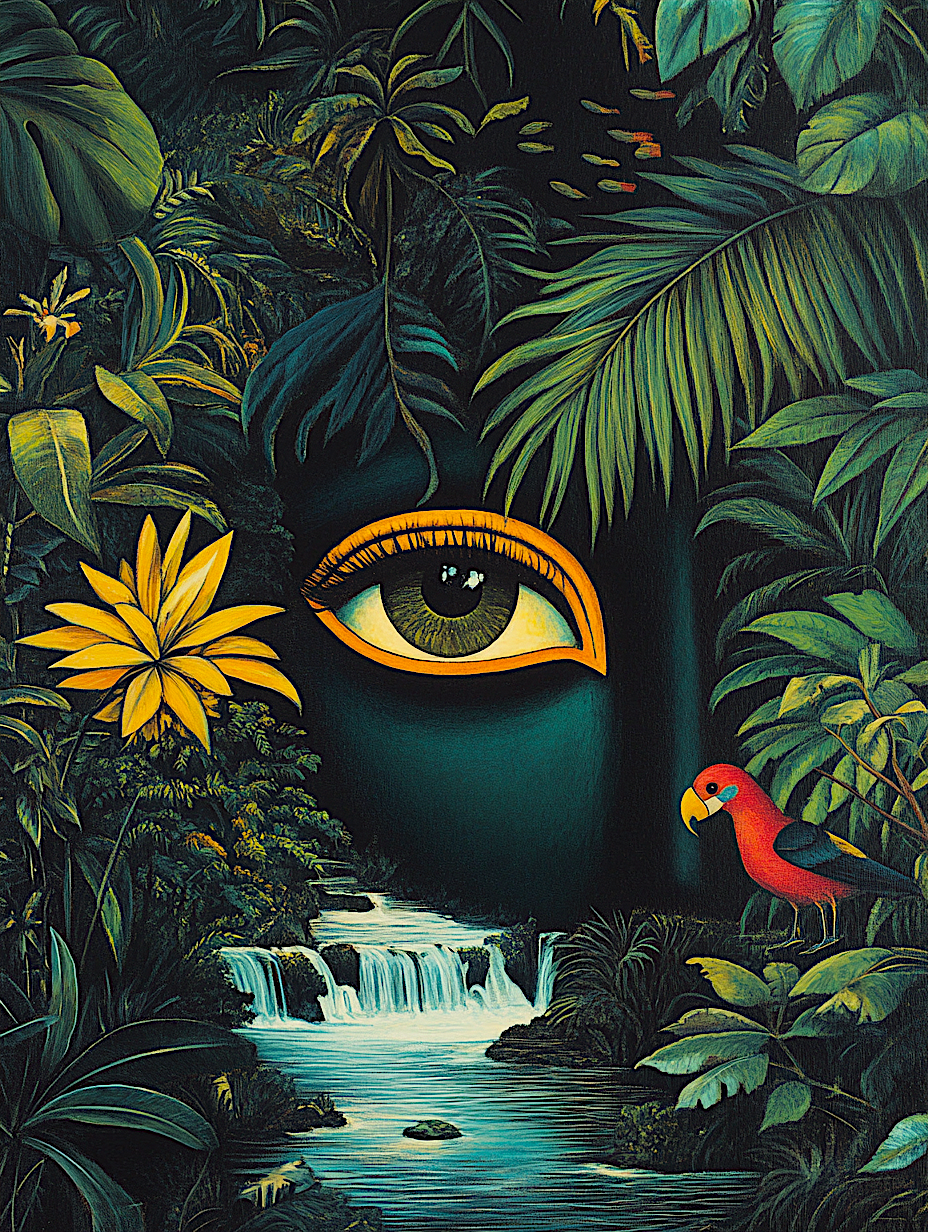
Image: Christmas Cataract on the River Berbice, Guiana (AI-assisted digital image) by O:JA&L staff creative. 2025. Public domain via Midjourney AI.
OJAL Art Incorporated, publishing since 2017 as OPEN: Journal of Arts & Letters (O:JA&L) and its imprints Buttonhook Press, HOT BUTTON PRESS Contemporary Issues, and HIGH BUTTON PRESS Contemporary Art, supports writers and artists worldwide.
Explore O:JA&L’s Buttonhook Press offerings on Amazon.
Subscribe to the O:JA&L YouTube channel.
Become an O:JA&L Member through Patreon.
Support Pamelyn Casto’s text for writers: Flash Fiction: Alive in the Flicker
Support O:JA&L’s free presses.

