

HAL: Heuristic Analysis Library
O:JA&L Guides & Rubrics
O:JA&L’s Written Cowboy Poetry Analysis and Evaluation Rubric
Click on the title to explore or download the free PDF document.
Click HERE to explore the expanding catalog of titles at O:JA&L’s DALLY POST PRESS.
Written Cowboy Poetry Analysis and Evaluation Rubric
This rubric supports consistent, evidence-based evaluation of written Cowboy Poetry, including traditional rhymed and metered work rooted in ranching, trail, rodeo, and rural Western life, as well as contemporary poems practiced across the trans-Mississippi West. Evaluators should consider both the poem as a written literary artifact and its connection to Cowboy Poetry’s oral, communal, occupational, and regional traditions: narrative accessibility, memorable sound, vernacular authority, humor or pathos, relationship to land and animals, and respect for lived Western experience.
Scoring note: Evaluate conventions, dialect, occupational vocabulary, Spanish, Indigenous, African American, immigrant, and regional language influences, spelling choices, and grammatical variation in relation to purpose, audience, genre, and voice. Do not penalize nonstandard usage when it is purposeful, controlled, respectful, and effective. Cowboy Poetry may be plainspoken without being simplistic; accessibility should be judged alongside craft, precision, and artistic depth.
Scoring note: This rubric uses a threshold scale rather than a continuous five-point scale. A score of 3 represents the minimum acceptable performance for a category. A score of 1 indicates performance below minimum expectations, while scores of 4 and 5 indicate increasing levels of proficiency and mastery. Because 3 is the threshold for acceptable performance, no score of 2 is used. To calculate weighted points, divide the category score by 5 and multiply by that category’s maximum value. The six weighted values total 100 points.
| Category | Weight | Score 1 / 3 / 4 / 5 | Weighted score | Quick note |
| Language, dialect, and conventions | 10 | ____ / 5 | ____ / 10 | ________________ |
| Form, narrative structure, and tradition | 15 | ____ / 5 | ____ / 15 | ________________ |
| Sound, rhythm, rhyme, and oral presence | 15 | ____ / 5 | ____ / 15 | ________________ |
| Diction, voice, and Western vernacular | 15 | ____ / 5 | ____ / 15 | ________________ |
| Subject, theme, imagery, and place | 15 | ____ / 5 | ____ / 15 | ________________ |
| Authenticity and genuineness | 15 | ____ / 5 | ____ / 15 | ________________ |
| Unity of impression and audience effect | 15 | ____ / 5 | ____ / 15 | ________________ |
| Total weighted score | ____ / 100 | Percentage: ____ % | ||
| LANGUAGE, DIALECT, AND CONVENTIONS | 1 Point
Grammar, punctuation, spelling, capitalization, or usage frequently interfere with meaning, and dialect or regional language appears accidental, stereotyped, or uncontrolled. |
3 Points
Language is generally controlled enough to support meaning. Dialect, idiom, or ranch vocabulary may appear, though consistency and purpose may be uneven. |
4 Points
Conventions and departures from convention are deliberate. Dialect, occupational terms, and regional phrasing strengthen voice, rhythm, tone, and cultural setting. |
5 Points
Language use is precise, respectful, and artistically necessary. Regional speech, code-switching, humor, and plainspoken phrasing feel fully controlled and integral to meaning. |
| Evaluator remarks for Language conventions: ________________________________________________________________________________________________ | ||||
| FORM, NARRATIVE STRUCTURE, AND TRADITION | 1 Point
Structure appears arbitrary, incomplete, or confusing. Narrative movement, stanza pattern, lineation, or relation to Cowboy Poetry tradition is weak or unclear. |
3 Points
The poem uses an identifiable structure, often narrative or anecdotal, that generally supports meaning. Traditional forms or contemporary variations are present but may be uneven. |
4 Points
Form is deliberate and effective. Line breaks, stanzas, pacing, story arc, turn, and ending reinforce Cowboy Poetry’s oral/narrative inheritance and the poem’s written shape. |
5 Points
Form is highly controlled and integral to interpretation. The poem honors, extends, or knowingly revises tradition through memorable structure, momentum, and closure. |
| Evaluator remarks for Form: ________________________________________________________________________________________________ | ||||
| SOUND, RHYTHM, RHYME, AND ORAL PRESENCE | 1 Point
Sound choices are minimal, accidental, or distracting. Meter, rhyme, repetition, cadence, or phrasing do not clearly support meaning or read-aloud effectiveness. |
3 Points
The poem uses some purposeful rhythm, rhyme, repetition, or cadence. It can be read aloud with a generally clear beat, though effects may be inconsistent. |
4 Points
Sound is controlled and expressive. Meter, rhyme, internal echo, repetition, pauses, and plainspoken music reinforce voice, humor, emotion, and memorability. |
5 Points
Sonic design is memorable and integral. The poem carries strongly on the page and in the mouth, with cadence suited to recitation and rooted in Cowboy Poetry’s oral tradition. |
| Evaluator remarks for Sound: ________________________________________________________________________________________________ | ||||
| DICTION, VOICE, AND WESTERN VERNACULAR | 1 Point
Word choices are vague, generic, romanticized, or clichéd. Western terms may feel pasted on, inaccurate, or unsupported by voice and situation. |
3 Points
Diction is generally appropriate to subject, speaker, and audience. Some words, idioms, or occupational details are vivid, though precision and freshness may vary. |
4 Points
Word choice is specific, economical, and engaging. Vernacular, humor, technical terms, understatement, and figurative language deepen voice and credibility. |
5 Points
Diction is striking, exact, and memorable. The poem’s voice feels earned; each word contributes to character, place, emotional resonance, and artistic authority. |
| Evaluator remarks for Diction: ________________________________________________________________________________________________ | ||||
| SUBJECT, THEME, IMAGERY, AND PLACE | 1 Point
Subject or theme is unclear, overly general, or dependent on stock Western imagery. Details of land, work, animals, community, or history are thin or disconnected. |
3 Points
Theme is identifiable and supported by some concrete images. The poem engages ranch, rodeo, trail, rural, or Western life, though development may be familiar or uneven. |
4 Points
Theme is thoughtfully developed through vivid images of place, labor, animals, weather, travel, memory, community, humor, loss, endurance, or change across the West. |
5 Points
Theme and imagery are richly integrated. The poem reveals layered significance in Western experience without flattening culture into nostalgia, caricature, or scenery. |
| Evaluator remarks for Theme / Imagery: ________________________________________________________________________________________________ | ||||
| AUTHENTICITY AND GENUINENESS | 1 Point
The poem feels derivative, performative, or based on clichés rather than observed knowledge. It may appropriate, sentimentalize, or stereotype Western people, labor, or cultures. |
3 Points
The poem shows some credible relation to Western experience, tradition, or research. Sincerity is evident, though details, perspective, or emotional authority may be uneven. |
4 Points
The poem feels genuine, respectful, and grounded in lived experience, close listening, documented knowledge, or responsible imaginative entry. It avoids easy mythmaking. |
5 Points
Authenticity is deeply earned. The poem speaks with humility, specificity, and moral clarity, honoring Cowboy Poetry’s communities while allowing complexity, contradiction, and change. |
| Evaluator remarks for Authenticity and Genuineness: ________________________________________________________________________________________________ | ||||
| UNITY OF IMPRESSION AND AUDIENCE EFFECT | 1 Point
The poem lacks a clear overall effect. Craft elements, subject, voice, and tradition feel disconnected or unintentionally inconsistent. |
3 Points
The poem creates a generally coherent impression for readers familiar or unfamiliar with Cowboy Poetry, though some choices may feel underdeveloped. |
4 Points
The poem demonstrates a strong unified effect. Structure, sound, voice, imagery, authenticity, and theme work together to engage a broad audience. |
5 Points
The poem achieves a compelling total impression: readable, speakable, memorable, culturally grounded, emotionally resonant, and artistically complete. |
| Evaluator remarks for Unity of Impression and Audience Effect: ________________________________________________________________________________________________ | ||||
This rubric is intended as a guiding instrument rather than a substitute for informed critical judgment. Apply it consistently and transparently while recognizing that Cowboy Poetry includes old-time and contemporary forms; written and performed traditions; ranch, rodeo, farming, reservation, borderlands, plains, mountain, desert, and small-town perspectives; and diverse communities across the trans-Mississippi West. Final scores and remarks should be based on observable evidence in the work, the writer’s apparent intentions, the poem’s relation to Cowboy Poetry traditions, and the degree to which its choices create a coherent, genuine, and meaningful artistic effect.
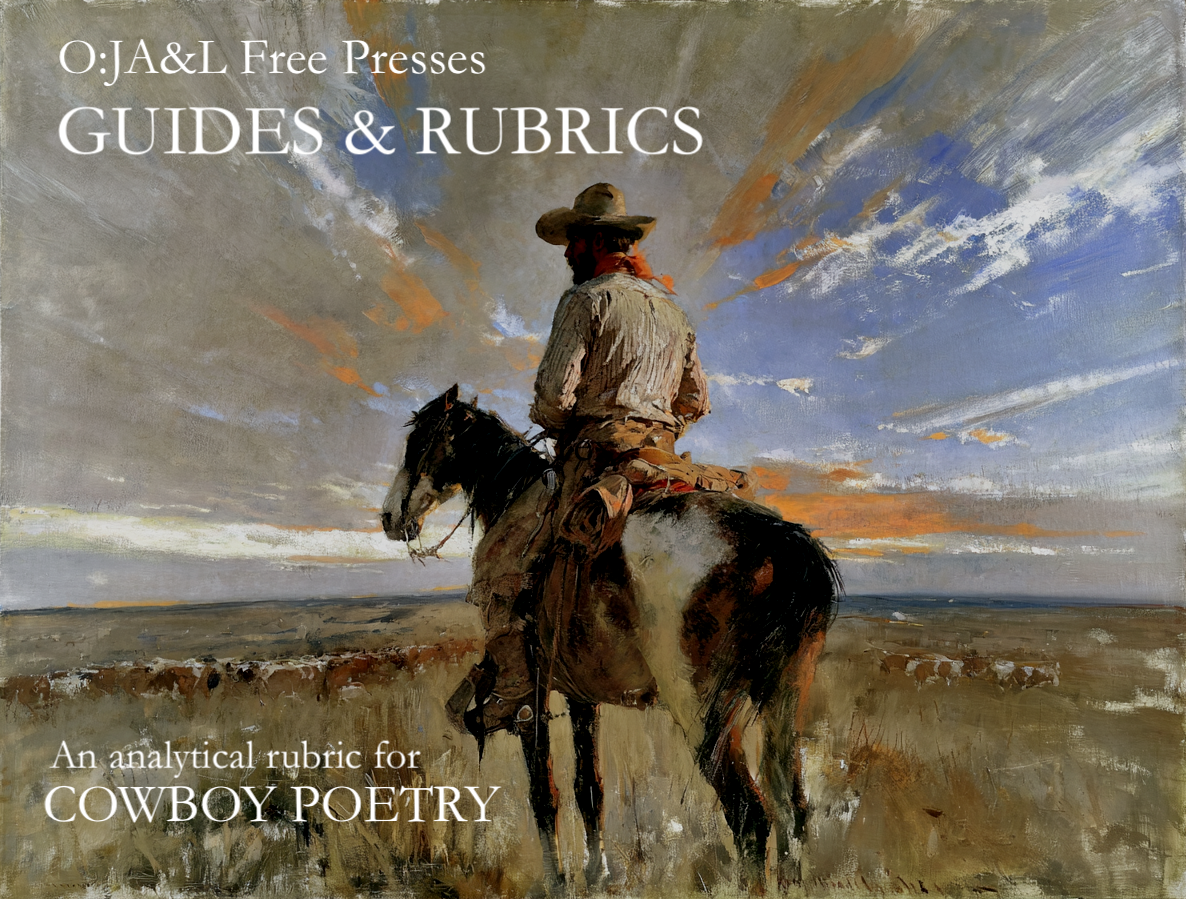
Image: First Guard (SI-assisted digital image) by O:JA&L staff creative. 2026. Public domain via Midjourney AI.
These projects were made possible, in part, through support from
Grayling and Wraith, a growth marketing company.

OJAL Art Incorporated, publishing since 2017 as OPEN: Journal of Arts & Letters (O:JA&L) and its imprints Buttonhook Press, HOT BUTTON PRESS Contemporary Issues, and HIGH BUTTON PRESS Contemporary Art, supports writers and artists worldwide.
O:JA&L’S FREE PRESSES
CLICK ON THE IMPRINT TITLES TO EXPLORE THE OFFERINGS
Buttonhook Press
HOT BUTTON PRESS: Contemporary Controversies
HIGH BUTTON PRESS: Contemporary Art
FIREFIGHT PRESS: Trench Arts & Letters
DALLY POST PRESS: Cowboy Poetry
QUARTOS & QUIRES: Writing for Page, Stage & Screen
HAL: Heuristic Analysis Library

