

HAL: Heuristic Algorithmic Library
Poetry: All forms & styles
A Featured Series of Close Readings
PROCEDURAL DREAD
and the Diagnosis of Civic Disempowerment
A Contextual Reading of “I Misplace My Humanity at the Grocery Store”
a poem by Samantha Padgett
Click HERE to read the poem “I Misplace My Humanity at the Grocery Store.”
Click HERE to read an alternative interpretation.
Click HERE to download this PDF pamphlet.
Most contemporary readings of Samantha Padgett’s poem “I Misplace My Humanity at the Grocery Store” would situate it within the cultural context of normalized gun violence in the United States, emphasizing fear, resignation, and the psychic toll of living under the constant anticipation of harm. Such interpretations rightly underscore the poem’s affective intensity and its engagement with contemporary American anxieties. This essay adopts a contextual reading of Padgett’s poem, but one that shifts the frame of reference from violence itself to the civic and institutional conditions that shape how that violence is experienced, absorbed, and normalized.
Rather than treating the poem solely as an emotional response to firearms or public danger, this analysis situates it within a broader context of procedural governance and civic disempowerment. Read against traditions of civic republican thought, the poem’s pervasive atmosphere of drills, lines, rehearsals, and ritualized waiting reflects not simply fear, but the consequences of a social order that substitutes procedural management for individual agency. The poem’s dread, on this reading, is not merely expressive; it is diagnostic, revealing the psychological effects of living in a society where responsibility for safety has been increasingly transferred from citizens to institutions.
This contextual approach does not claim that Padgett intended a constitutional argument, nor does it enlist the poem as an act of political advocacy. Instead, it treats the poem as a cultural artifact that inadvertently illuminates the affective landscape of contemporary civic life. Read through a constitutional lens—specifically, in relation to the civic logic historically associated with the Second Amendment—the poem exposes a population trained to comply, rehearse vulnerability, and wait for protection rather than to exercise judgment, preparedness, or self‑governance.
By situating “I Misplace My Humanity at the Grocery Store” within this civic and institutional context, this essay argues that the poem offers a compelling case study in procedural dread: a condition in which fear persists not because danger is omnipresent, but because agency has been systematically eroded. The poem’s power lies in its clarity. It shows, with unsettling calm, what it feels like to inhabit a society that has learned to stand in line.
Read through a constitutional lens, the poem exposes a society that has transferred responsibility for safety entirely to institutions, rehearsing vulnerability and all the while eroding agency. From this perspective, the poem inadvertently illuminates the civic conditions the Second Amendment was historically designed to counteract—conditions marked by passivity, compliance, and dependence rather than preparedness and self‑governance. The poem’s final stillness does not resolve fear; it normalizes it.
The poem opens with a gesture of minor transgression: the speaker peels stickers from apples and hides them “under my tongue,” likening the act to forbidden gum from school (lines 1–4). While often read as a sign of infantilization or quiet rebellion, this moment can also be understood as a symptom of constrained agency. The speaker’s defiance is trivial, furtive, and bodily concealed, suggesting that meaningful action has been displaced into symbolic or private gestures. The grocery store—a site of choice and consumption—ironically becomes a space where the speaker feels monitored and restricted, rehearsing obedience even in abundance. Humanity, the poem suggests, is “misplaced” not through overt force, but through the quiet internalization of regulation.
This internalization becomes explicit when the poem folds religious memory into contemporary fear. The speaker recalls stained glass, confessionals, and mass alongside “mass shootings” (lines 5–9), compressing sacred ritual and public violence into a single cognitive field. The flat declaration “I’m not sad” (line 10) registers not resilience, but affective depletion. In a diagnostic reading, this numbness reflects not merely trauma, but the consequences of habituation: a population trained to absorb fear without response. The poem does not depict citizens preparing for danger; it depicts subjects absorbing it.
The childhood drill scene sharpens this diagnosis. Lined up against a chain‑link fence at age twelve, the speaker and her classmates are told it is “a drill,” even as one girl insists they are being prepared for execution (lines 11–15). The poem refuses to correct the girl’s fear. Instead, it preserves the ambiguity—“maybe they are / were” (lines 16–17)—suggesting that rehearsal and reality have collapsed. From a constitutional perspective, this collapse signals a failure of civic formation. Rather than cultivating readiness, judgment, or responsibility, the drill trains children in compliance and silence. Safety becomes something administered, not enacted.
Through form and structure, the poem reinforces this vision of uncomplaining acquiescence and its corollary of inaction through fragmentation and enjambment. Thoughts arrive discontinuously; time collapses; white space interrupts syntax. The speaker’s mind moves reflexively rather than deliberately, governed by anticipation rather than choice. This structure mirrors a culture that substitutes procedure for agency. The reader encounters no moment of decision, resistance, or preparation—only repetition. In this sense, the poem’s form enacts the very condition it describes: a self that is shaped by protocols rather than principles.
The poem’s brief turn to technological competence—texting fluently on a Motorola phone without looking (lines 19–22)—momentarily gestures toward mastery and skill. The speaker’s thumb “jackhammering the buttons” conveys speed, control, and embodied knowledge. Yet this agency is immediately absorbed back into the poem’s governing logic when the speaker returns to the refrain of execution: “when they did line us up for execution / which is to say” (lines 24–25). The phrase “which is to say” becomes diagnostic shorthand, translating past drills into present routines. Skill without civic application proves insufficient; competence remains private, disconnected from collective responsibility or self‑defense.
The poem’s most explicit diagnosis occurs when childhood drills are equated with the adult self‑checkout line: “when they do line us up at the self‑checkout” (line 26). The self‑checkout epitomizes procedural modernity—automation, surveillance, and silent compliance. The speaker’s apples, stripped of stickers, are “naked,” likened to “collarless dogs” (lines 27–28), images that suggest domestication without protection. The speaker imagines herself “dead‑ / ly quiet” (lines 29–30), a phrase that fuses obedience with mortality. In a pro–Second Amendment diagnostic reading, this silence signifies not virtue, but civic atrophy: bodies trained to wait rather than act.
Religious imagery intensifies the poem’s portrayal of displaced authority. The Father’s blessing delivered “with the gun’s panting mouth” (lines 31–32), suggests that moral and protective authority has been replaced by impersonal force. Yet notably, the gun here is not wielded by the speaker; it is external, looming, and uncontested. The poem does not depict armed agency, but armed domination. When the speaker concludes, “Of course, I’ll accept this communion — / I’ve been waiting for it” (lines 33–34), the acceptance reads as exhaustion rather than consent. From a constitutional perspective, this ending functions as a warning: a society that conditions acceptance without agency risks mistaking submission for safety.
Read diagnostically, Padgett’s poem does not argue against constitutional self‑defense; rather, it exposes the psychic landscape that emerges when individuals no longer imagine themselves as responsible for their own protection or for one another’s. The Second Amendment, in its original civic‑republican logic, presupposes citizens capable of judgment, restraint, and readiness. The poem’s world is the inverse: a culture of drills without empowerment, rituals without responsibility, and fear without recourse.
In this light, “I Misplace My Humanity at the Grocery Store” can be understood as a negative case study—a portrait of what happens when procedural systems replace civic agency. The poem’s power lies in its clarity: it shows, with unsettling calm, a population trained to stand still. A pro–Second Amendment reading does not claim the poem endorses constitutional self‑defense, but that it inadvertently diagnoses the dangers of its absence. Humanity is misplaced not because danger exists, but because the capacity to respond has been surrendered to procedure.
ABOUT SAMANTHA PADGETT:
SAMANTHA PADGETT holds an MFA in Creative Writing, Publishing, and Editing from Sam Houston State University. Her work has appeared or is forthcoming in Black Warrior Review, Fourteen Hills, Salt Hill Journal, Pinch, North American Review, and elsewhere. She lives in Austin, Texas, with her partner and their cats.
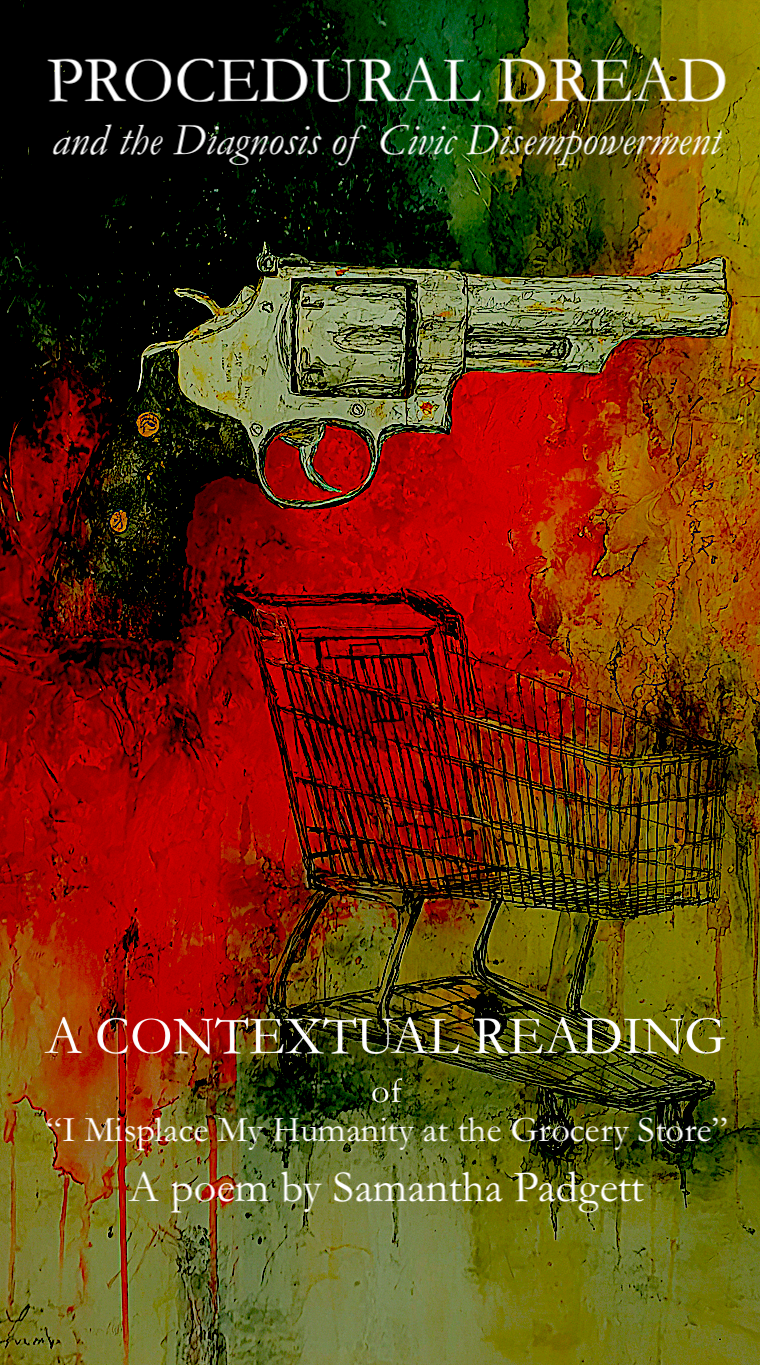
Cover image: At the Piggly Wiggly (AI-assisted digital image) by O:JA&L staff creative. 2026. Public domain via Midjourney AI.
This project was made possible, in part, through support from
Richard Stimac and his new book BLOOD, WATER, AND STONE
available now from Spartan Press.
OJAL Art Incorporated, publishing since 2017 as OPEN: Journal of Arts & Letters (O:JA&L) and its imprints Buttonhook Press, HOT BUTTON PRESS Contemporary Issues, and HIGH BUTTON PRESS Contemporary Art, supports writers and artists worldwide.
O:JA&L’S BUTTONHOOK PRESS MASTERS SERIES
Click on the titles below to explore or download the free PDF chapbooks in the O:JA&L Masters Series.
The Buttonhook Press Masters Series: Brian Clements on Prose Poetry
With an Interview by Associate Editor Pamelyn Casto
The Buttonhook Press Masters Series: Mark Budman on Flash Discourse
With an Interview by Associate Editor Pamelyn Casto
The Buttonhook Press Masters Series: Ray Gonzalez on Prose Poetry
With an Interview by Associate Editor Pamelyn Casto
The Buttonhook Press Master Series: Michael Martone on Flash Fiction
With an Interview by Associate Editor Pamelyn Casto
The Buttonhook Press Master Series: Roberta Allen on Flash Fiction
With an Interview by Associate Editor Pamelyn Casto
The Buttonhook Press Master Series: Peter Conners on Flash Fiction
With an Interview by Associate Editor Pamelyn Casto
The Buttonhook Press Masters Series: Maxine Chernoff on Prose Poetry
With an Interview by Associate Editor Pamelyn Casto
The Buttonhook Press Masters Series: Pedro Ponce on Flash Fiction
With an Interview by Associate Editor Pamelyn Casto
The Buttonhook Press Masters Series: Tom Hazuka on Flash Fiction
With an interview by Associate Editor Pamelyn Casto
The Buttonhook Press Masters Series: Kent Dixon on Flash Fiction & Nonfiction
With an interview by Associate Editor Pamelyn Casto
MORE TITLES IN PRESS

