

The O:JA&L Masters Series
Flash Discourse: Fiction/Nonfiction
An Essay on Craft
Kent Dixon
Flash Discourse: A Physical Artifact
Click on the title FLASH AS FLASH CAN to explore or download the new chapbook offering from Kent Dixon in the O:JA&L Masters Series.
So you want to write a flash fiction. But where to begin, how do you start?
Writer alert: you just started. Jot down the first things that come to mind as you sit there wondering how to start. No matter if it’s false starts: He is a man who… Or if its initial rhythms are junk, or if you have to unload the dishwasher first. Look at that: you’re already half way. All you have to do now is ride out that jerky momentum to an ending.
I have one in my collection in Open:JA&L, tediously entitled ‘Story Starts,’ beginning:
He is one of those who. A kind of. What is needed in this particular story
is not words. Words say things like voices in the hall, voices upstairs, the
wooshy voices of dropping off to sleep.
Spite the voices, what’s called for here is rhythm.
That he has no rhythm.
It continues to undo these starts for five more lines and then delivers an ending that—well, how would you end it? If you’re truly a rank beginner you’d likely reach for an upbeat ending, some kind of success with getting started. Whoopee for you.
Pretty dull. If you ‘ve lived long enough between creative sparks and words on a page, it’s more likely you’d take us to a downbeat ending, i.e., failure. Or failure made useful, or funny, or . . .
The question then is how do you shape that failure? You want it to reach out and embrace everyone who’s ever been in this writer’s limbo, and that is one of the big secrets of the short short. It explodes, in its meaning and feeling and fellow travelers, whereas a short story tends to the opposite. It contracts, narrows down to one strongly felt point, going back to Edgar Allen Poe’s ‘unity of effect.’ Every line should build toward a specific intended ending, said Poe. The best in each genre do both I imagine. Here’s a miniscule flash doing both, by one of the great practitioners of the form, Lydia Davis:
Tropical Storm
Like a tropical storm, I, too, may one day
become better organized.
You might be able to tie that in a lifetime, but for my money, I don’t think you can beat it. And all she did to get going was overhear a weather broadcast and say to herself, Yeah, right, sounds like me . . . but then, notice how she laid that out. You get the subject both barrels at the start: title and opening phrase. At some level then you’re caught up in thinking about tropical storms, ones you’ve been in, the amazing gusts, the collisions with rain, the ones that grew up to be really mean, and along comes your protagonist, with little stalls around her—those commas. And then that crucial ‘too’! Read this with the 2nd and 3rd commas and the ‘too’ removed: it doesn’t work, worse than flat. How can a wee ‘too’ provide that much suspense, eh?
Because that ‘too’ is the heart of this little thing, as important as the soft-peddled simile at ourselves matched up with our oh-so-amusing promises to ourselves to get the hell organized. Explosion: now we’re talking universals, or nearly so: people who don’t fit into this category are too uptight to write anything worthwhile anyway. And even that thought might well be part of your take on this 14 word short short.
Look at another tiny one which I find delightfully ‘explosive,’ by Susan Geryl Sherman in A Magazine of Paragraphs (Fall 1985):
These are the Seven Deadly Sins of Indecision:
1.
2.
3.
4.
5.
6.
7.
So what is this thing, a ‘concrete flash’? Is it a short-short at all, or a poem? Does it obey or subvert most of the ‘rules’ of both, including the line break? The magazine that published it got away with calling it a paragraph. Who cares; you’re well into thinking about your own sins of indecision and it’s not long before you become aware you’re in good company—most of the rest of the world. So, explosion to universal level once again.
Look again closely (trying to keep your eye from all that blankness you’d prefer to forget). Why seven? Oh, it’s the pride, anger, greed, lust thing, duh, the capital sins of Augustine and Acquinas and company—the Seven Deadly Sins. So we start out universal and then catch that ‘Indecision’ as we pass, and then—for me it took two beats: a glance down the proper numbers and then the blank page goes wham, in your face. It’s an LOL, right?
But then, do you linger? I do—over the cleverness, over the shared knowledge with the writer, over the common denominator of our humanness. That’s a lot for just eight words and seven numbers. In a book I recommend, Flash Fiction Forward (Thomas and Shapard), there’s a quote from a Richard Bausch:
. . . when a story is compressed so much, the matter of it tends
to require more size: that is, in order to make it work in so small
a space its true subject must be proportionately larger.
Next time your read a short short, hold this insight up to it as a litmus test. I think you’ll find that the ones that really stick with you have this expansive quality, or as these editors say of a poem, “…that allusive energy that floats you off the page and away from the artifact and into the empyrean of the symbolic, the universal.”
So if that’s what the best of these mini-stories do, how to get them there? Not everything you think of has universal implications. Or does it, or can it be made to?
Let’s write one. Back in the first paragraph I mentioned unloading the dishwasher, a dodge from getting down to writing that I often rely on. There’s also the laundry I can count on, got to get at least one load done today, provided the damn machine holds up; it hasn’t been draining well, even after I took it half apart, which was a comedy in reverse engineering—the hose, the puddles, the different screws, just getting the damn back of it off. Like a major surgery on a cyborg, which failed.
And where’s the universal in such malpractice? I feel a metaphor lurking. Of course! Struggling with this humping, drooling tin can of a one-eyed robot—what is that like? Furthermore, what feelings go with it—the frustration, the anger, the smell, the not having any idea of what I’m doing, the mess I left to go call a plumber. Shame? No, this was too funny for shame. In fact, I should share it with someone: the machine doesn’t like my wife any better than me:
Mimi and I took apart the washing machine because it
didn’t work.
Then what? Get some vivid detail in—the black hose, the stench of the bad water, the mess all around us:
We drained the slimy water out of the back, me with
the cordless drill, she harvesting lint from its pipes,
both of us sitting on it when it began to thump and walk . . .
Or, maybe try her point of view, get me out of it. In fact, get me as far from it as I can and put it into her point of view and then, to be even freer, let’s rejuvenate down to a young couple, who might have more fun with it than we would:
Billy and I took apart the washing machine because it didn’t work.
We drained the water out of the back. It pissed out of the black hose,
sneaked up the cuffs of my pants—hilarious. It smelled: slimy old
spring freshness. We turned the power off. We took all the screws out
of the back.
Can you tell me where this is going? (Maybe some telling key words here, centrifugal possibilities : pissed, pants, freshness, screws—words have auras just as insistent as their origins.) For starters, I like this couple: by her voice she’s cute, and he’s right along there with her, and how to interpret that ‘hilarious’? Comic irony on her part, or it just was really funny? Either way, it puts us in a pretty good mood.
We turned the power off. We took all the screws out of the back.
Used my cordless drill. The back was rusted on. We jerked it off.
We left the water hooked to it, maybe hoping to end up wet and
laughing in the basement with the washing machine in pieces and
the pipes rusty and the drain choking, drowning, spitting up dryer
lint like post-CPR convulsions. We pulled and pushed, slammed
on it. I sat on top and he pulled . . .
And if you can’t tell by now where this is going—via just the word ‘auras’ alone—well, that’s mighty asexual of you. For those of us without early childhood trauma or whatever, the fun becomes the anticipation of the climax, how soon will the narrator get there, how obvious will it be, and ultimately, though one is probably not thinking this now: will she be able to zoom out from a good romp in that slimy old spring freshness to something even larger, maybe a little less embarrassing, a little less specific, a little more universal?
Billy and I took apart the washing machine because it didn’t work.
We drained the water out of the back. It pissed out of the black hose,
sneaked up the cuffs of my pants—hilarious. It smelled: slimy old
spring freshness. We turned the power off. We took all the screws out
of the back. Used my cordless drill. The back was rusted on. We jerked
it off. We left the water hooked to it, maybe hoping to end up wet and
laughing in the basement with the washing machine in pieces and the
the pipes rusty and the drain choking, drowning, spitting up dryer lint
like post-CPR convulsions. We pulled and pushed, slammed on it. I sat
on top and he pulled and I had my hands on the ceiling and still it was
lifting up off the greasy soapy silty and ridiculously concrete floor. And
with heaves and sweat—with newly filthy clothes we wouldn’t be able
to wash—we got the fucking thing apart without knowing what to do
next. Billy and I left it gutted in the basement so it could think about
what it had done to us.
And there you have a pretty darn good short short, by one Sarah Garrison, written for my beginning Creative Writing course and subsequently published in A Magazine of Paragraphs, Summer 2004. And all she needed was a little time with an end-stage washing machine, and the freedom and inventiveness to make a conceit out of it.
And my closing point here would be why flash fiction is so salubrious for the writer, and for teaching writing, and for quick trips to ‘the empyrean of the symbolic.’ You don’t have to be a seasoned writer to get a good one. Sarah was seventeen when she wrote this. Write ten, I guarantee you at least one will be published. And you can do that in a month or a week, in the time it takes to write one short story. And writing ten of these shorts sharpens all the tools you possess, especially if you read around and branch out from realism into the genre’s rich varieties—the prose poem, magical realism, outright surrealism, concrete possibilities, meta-whatever. And blends of all these, as Sarah pretty much accomplished here.
Afterthought on the concrete: I mentioned how important that ,too, was in that minute Tropical Storm piece. Look back at the seven types of indecision. Can you see how, surely without knowing it, you read that title as a first line rather than as a staid title, because of that unnoticeable but indispensable colon. Without that colon, you’d lose the whole implied agony of not quite being able to make a choice about something—that whole emotional limbo-like drama. The colon puts you in the action.
So this is an extra-credit on the workings of Flash. How does it look on the page, as an artifact, that can be taken in in a single glance? What is the paragraphing, or as in the two I’ve cited, what does the punctuation do for it? So in a way, all shorts are ‘concrete,’ especially if you experience the whole thing from one page, or if two pages, then where that break comes in the story can be critical for best effect.
One more example of the importance of this ‘concrete effect.’ Look back to the opening of this essay, where I dole out five lines of my short short called “Story Starts.” Notice the use of paragraphing. If I’d lumped all those short lines into one fat paragraph, the whole effect of being stalled would be swallowed by print. Those half-line paragraphs with the following space—I don’t know, maybe I stole them from Indecision x 7, then forgot them, then came up with them in rush of creativity, which, as you know, is how writing works best. Too.
About the writer:
Kent Dixon completed his undergraduate work at UNC Chapel Hill, his MA at Johns Hopkins, and his PhD at the Iowa Writers Workshop. Dixon has taught high school and college and has published in all genres, mostly fiction and CNF, but including translations of French Symbolist Poets. He has published a graphic novel of The Epic of Gilgamesh in collaboration with artist son.
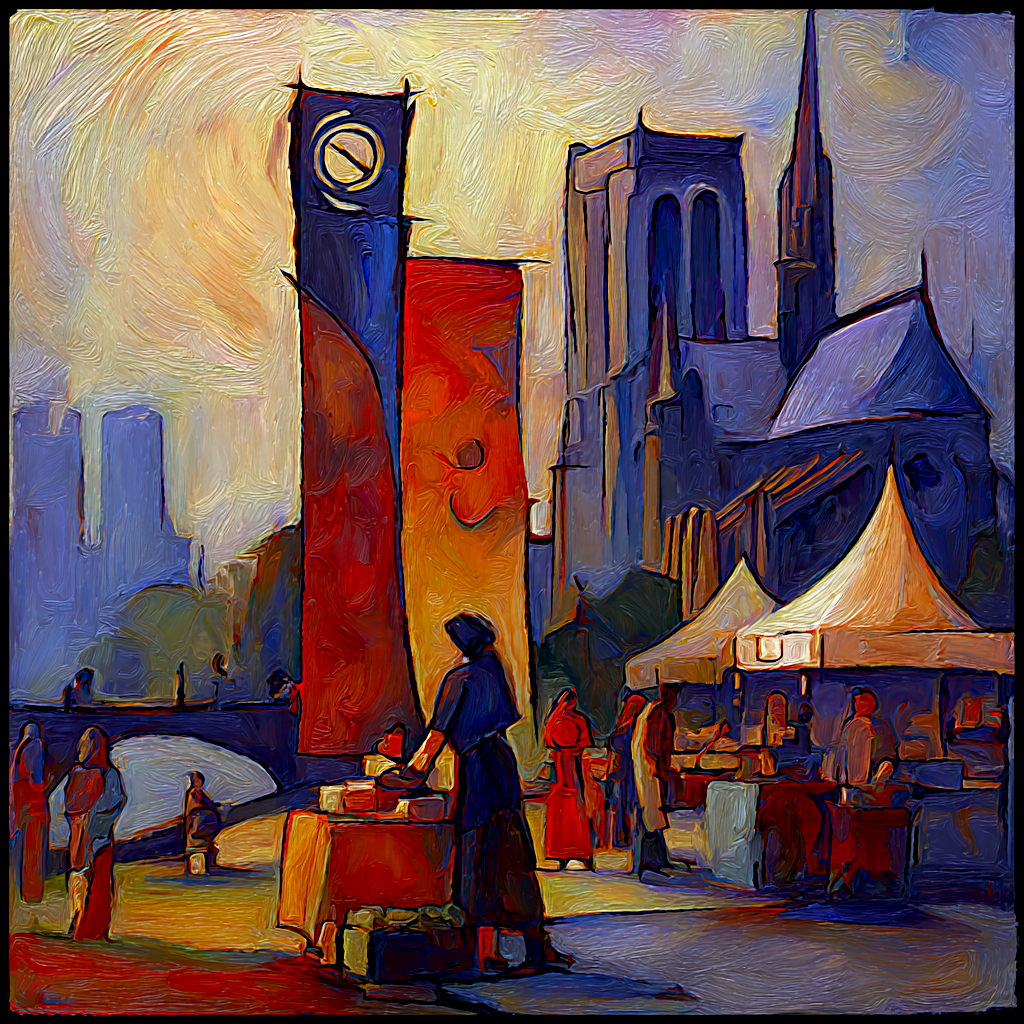
Image: Saturday Pleinaire (AI-assisted digital image) by O:JA&L staff creative. 2025. Public domain via Midjourney AI.
Other works by Kent Dixon available on O:JA&L:
Featured Writer Kent Dixon|An Essay on Craft|”Flash Discourse: The Long of the Short of It”
Featured Writer Kent Dixon|Flash Fiction|”It Wasn’t Me”|(from WIP Not for Sunday School)
Featured Writer Kent Dixon|Flash Fiction|”Older Brother James”|(from WIP Not for Sunday School)
OJAL Art Incorporated, publishing since 2017 as OPEN: Journal of Arts & Letters (O:JA&L) and its imprints Buttonhook Press, HOT BUTTON PRESS Contemporary Issues, and HIGH BUTTON PRESS Contemporary Art, supports writers and artists worldwide.
O:JA&L’S BUTTONHOOK PRESS MASTERS SERIES
Click on the titles below to explore or download the free PDF chapbooks in the O:JA&L Masters Series.
The Buttonhook Press Masters Series: Brian Clements on Prose Poetry
With an Interview by Associate Editor Pamelyn Casto
The Buttonhook Press Masters Series: Mark Budman on Flash Discourse
With an Interview by Associate Editor Pamelyn Casto
The Buttonhook Press Masters Series: Ray Gonzalez on Prose Poetry
With an Interview by Associate Editor Pamelyn Casto
The Buttonhook Press Master Series: Michael Martone on Flash Fiction
With an Interview by Associate Editor Pamelyn Casto
The Buttonhook Press Master Series: Roberta Allen on Flash Fiction
With an Interview by Associate Editor Pamelyn Casto
The Buttonhook Press Master Series: Peter Conners on Flash Fiction
With an Interview by Associate Editor Pamelyn Casto
The Buttonhook Press Masters Series: Maxine Chernoff on Prose Poetry
With an Interview by Associate Editor Pamelyn Casto
The Buttonhook Press Masters Series: Pedro Ponce on Flash Fiction
With an Interview by Associate Editor Pamelyn Casto
The Buttonhook Press Masters Series: Tom Hazuka on Flash Fiction
With an interview by Associate Editor Pamelyn Casto
The Buttonhook Press Masters Series: Kent Dixon on Flash Fiction & Nonfiction
With an interview by Associate Editor Pamelyn Casto
MORE TITLES IN PRESS

