

Associate Editor Pamelyn Casto
A Close Reading of Spencer Holst’s
“The Zebra Storyteller”
See the story at http://www.archipelago.org/vol3-1/holst.htm
Spencer Holst was an American writer known for writing fractured fairy tales, fables, and puzzles. He enjoyed playing with reader expectations and he often used literary devices that made what’s old new again.
Holst’s “The Zebra Storyteller” is a delightful, amusing, and thought-provoking fable. It is also an open-ended fable that allows the reader to wrestle with the story’s ending moral.
Holst opens his story with “Once upon a time.” This opening has served as the beginning to countless stories throughout history. In using such an opening Holst makes the old new again as he plays with reader expectations and reader notions about what fables and storytelling are to do.
His first sentence is loaded: “Once upon a time there was a Siamese cat who pretended to be a lion and spoke inappropriate Zebraic.”
With his opening, Holst places readers squarely into the land of fables. Fables demonstrate a lesson about human behavior, and in this story is a talking animal with human characteristics (the traditional subject of fables) This talking cat not only speaks in his own language but speaks an additional language as well. He learned the second language so he could prey upon zebras (as lions will often do).
Right away, readers are told that the Zebraic language the cat learned was inappropriate and that the Siamese cat was a fraud; a cat who pretended to be something other than what he was. He pretended to be a lion.
The fraudulent little cat met a zebra and pretended to be friendly and polite as he greeted the zebra in perfect Zebraic. The story, alluding to a much older fable, shows how someone might be friendly and polite, yet still be a villain. As is the style of fables through the ages, the story shows characters that are anthropomorphic animals.
When the astonished zebra heard his own language spoken by the cat, he was fit to be tied. So the cat literally did just that—tied up the zebra, killed him, and took his better parts to his den to dine on and used the zebra’s other parts to make bow neckties and wide belts. The cat preyed upon other zebras in this way as well.
The cat also boasted and insisted to his cat friends that he truly was a lion and the proof was in the fact that he hunted zebras (as lions do). So the cat not only deceived the zebras but deceived his fellow cats as well. He was an imposter, a fraudulent storyteller.
The cat is not the only one to tell stories. The zebras do it too. To explain the zebra-destroying events, the zebras became superstitious and made-up stories to explain the frightening events to themselves. Because they couldn’t smell a lion in their area where so many deaths had taken place, the zebras avoided the area and decided that their woods were haunted by the ghost of a lion. Since their proof of fact required smell, they provided themselves with a story to explain the strange events—the existence of a lion’s ghost.
Then, one day, the official storyteller for the zebras was on a search for plots to amuse the other zebras. He was suddenly inspired by the idea of a story about a Siamese cat who learns to speak Zebraic. The cat appeared and spoke to the storytelling zebra in his usual friendly, polite, and beguiling way. But there was something this zebra didn’t like about the cat’s look and he, unlike the first zebra, was NOT fit to be tied since he was thinking about that exact situation. So he kicked the cat and killed him. The story ends with this information, “That is the function of the storyteller.”
The entire fable plays with reader expectations. But what are readers to make of it? What is the moral of this fable? This is clearly a cautionary tale (as fables often are). It is also an allegory that demonstrates the power of storytelling. The heroic zebra was able to get readers to willingly suspend their disbelief and his story proved to be more powerful than the cat’s deceitful story.
Traditional fables offer a moral to the story but Holst’s fable offers a more open-ended moral. Instead of providing a clear moral, he allows readers to draw their own conclusions and make their own interpretations.
Both the cat and the zebras tell stories. The cat’s stories, however, are deceptive. The official zebra storyteller recognized and exposed the cat as a fraud and put a “The End” to the cat’s storytelling.
Perhaps that is the function of the storyteller; to tell better, more acceptable, less blatantly fraudulent stories. Or perhaps it means something else. Holst leaves it to his readers to figure out. As in the tradition of fables, anthropomorphic animals are used as characters in order to provide the opportunity to consider and sometimes even laugh at human foibles.
About Pamelyn Casto:
Pamelyn Casto, twice a Pushcart Prize nominee, has published feature-length articles on flash fiction in Writer’s Digest (and in their other publications), Fiction Southeast, and Writing World (and elsewhere). Her essay on flash fiction and myth appears in Rose Metal Press’s Field Guide to Writing Flash Fiction: Tips from Editors, Teachers, and Writers in the Field and her 8,000-word essay on flash fiction is included in Books and Beyond: The Greenwood Encyclopedia of New American Reading (4 volumes). She also has a 5,000-word article on flash fiction as the lead article in the new book Critical Insights: Flash Fiction. Subscribe to her free online monthly FlashFictionFlash newsletter (first issue published in 2001) for markets, contests, and publishing news for flash literature writers. Casto is an Associate Editor at O:JA&L. Pamelyn Casto’s new book Flash Fiction: Alive in the Flicker (A Portable Workshop), a new release from O:JA&L’s Buttonhook Press, is available now on Amazon. Explore more in Pamelyn Casto’s featured series of close readings: Pamelyn Casto: A Featured Series of Close Readings.
About Spencer Holst: Spencer Holst (1926-2001) was an American writer and storyteller notable for the live performances of his original works, which he conducted regularly in the New York area.
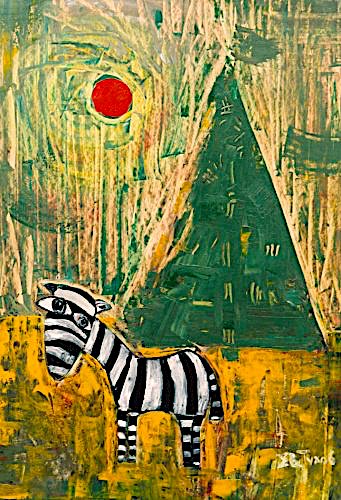
Image: The Sun, a Zebra, and a Cypress Tree by Sergey Evtuhov (1953-contemporary). Oil on cardboard. 100 x 70 cm. 1997. By free license.
OJAL Art Incorporated, publishing since 2017 as OPEN: Journal of Arts & Letters (O:JA&L) and its imprints Buttonhook Press, HOT BUTTON PRESS Contemporary Issues, and HIGH BUTTON PRESS Contemporary Art, supports writers and artists worldwide.
Explore O:JA&L’s Buttonhook Press offerings on Amazon.
Subscribe to the O:JA&L YouTube channel.
Become an O:JA&L Member through Patreon.
Follow O:JA&L on Facebook.
Support Pamelyn Casto’s text for writers: Flash Fiction: Alive in the Flicker
Support O:JA&L’s free presses.

