

Support Pamelyn Casto’s text for writers: Flash Fiction: Alive in the Flicker
Support O:JA&L’s free presses.
Associate Editor Pamelyn Casto
A Close Reading of Gordon Lish’s
“A Merry Chase”
Click HERE to read Lish’s story (about 1/3 the way down).
“The Merry Chase” is included in Sudden Fiction: American Short-Short Stories edited by Robert Shapard and James Thomas (Gibbs-Smith Publisher, Salt Lake City, 1986)
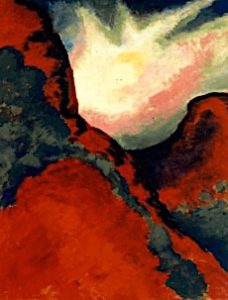
 Palo Duro Canyon by Georgia O’Keeffe
There are three striking features to notice and examine in Gordon Lish’s brilliant little story “A Merry Chase.” One, the story is plotless. It has no clear beginning, middle, and end. So many writers, editors, and readers insist that even flash fiction have a traditional plot so it is encouraging to come across an outstanding example of a flash/sudden fiction story without a straightforward plot structure. Many believe flash fiction requires a plot because this type of story is the easier type to teach. Since it’s more commonly taught, many writers, editors, and even readers assume it’s the preferred, the correct, or the only acceptable form for flash fiction. Lish’s story helps to dispel that myth.
The second feature of the story is how it’s told as a monologue. In a fit of frustration, the narrator directs a continuous stream of words toward an unnamed, silent, and non-responsive person. This intense emotional outpouring continues throughout the entire story.
The story’s third and most noticeable feature is that it is loaded with clichés. As a result, little or no genuine communication takes place. It’s mostly impossible to know what’s actually on the speaker’s mind, and his passionate attempt at getting his words across results in very little actual communication. The story is a fine example of the madness and futility of overdone cliché speak.
According to James Wood, writer and book critic at The New Yorker and author of How Fiction Works, “Cliché is our original sin, the thing we all try to escape, but the offense is not merely aesthetic or musical; it is epistemological—cliché blocks our apprehension of reality. In place of singularity, it substitutes commonality; in place of the private oddity, it offers the shared obviousness.” (This quotation was taken from his book review of Yaa Gyasi’s Transcendent Kingdom, Sept. 14, 2020 New Yorker.)
Wood’s words resonate profoundly with Gordon Lish’s “The Merry Chase,” a unique and captivating short-short piece. Despite its brevity, the story is a relentless cascade of clichés, a feature that sets it apart from conventional narratives.
Even the title is a cliché. “Merry chase,” a term dating back to the 1500s, means to cause someone trouble by wasting their time or sending them on a futile pursuit. The narrator claims he wants to tell the “unvarnished truth.” But even though he’s using common English, there are no clues about what has him so upset– his meaning has been varnished or lacquered over, layer after layer, thickness after thickness. All his many clichés put together don’t create meaning.
The upset and emotional narrator sums it up best when he says: “I can’t hear myself talk. I can’t hear myself think. I cannot remember from one minute to the next.” And yet he never stops talking in those amusing, if not tragic, clichés. How frustrating for him to think he’s getting his meaning across and how exasperating for the addressee who likely won’t be able to make head nor tail out of what’s upset the narrator (to use my own cliché in explaining.) The narrator is right when he says he can’t hear himself think since there are so many clichés crashing about in his head and spewing out of his mouth. The story is a merry chase of cliché after cliché. Rather than thinking for himself, the narrator’s clichés are taking over and obscuring and obfuscating his thinking.
At one point the exasperated narrator says to the person he’s addressing, “What do I say to you, where do I start with you, how do I make myself heard? I don’t know where to begin with you, I don’t know where to start with you, I don’t know how to impress on you the importance of every single solitary word.”
Sometimes his clichés or dead metaphors get so mixed that a reader will sometimes laugh out loud. Despite all those words, all those familiar words, all those common words, the silent recipient of the rant (or the reader) won’t be able to determine what has the narrator so riled. With this monologue, we are all being led on “a merry chase” for meaning.
The story is an outstanding commentary on how non-thinking and talking in clichés can obscure meaning. This passionate attempt at communication results in no meaningful communication at all. Just as James Wood warns, “cliché blocks our apprehension of reality.” Clichés have their important uses, but when overused, they refuse to communicate much at all. This story is a delight to read and is well worth contemplating.
About the writer:
Pamelyn Casto, twice a Pushcart Prize nominee, has published feature-length articles on flash fiction in Writer’s Digest (and in their other publications), Fiction Southeast, and Writing World (and elsewhere). Her essay on flash fiction and myth appears in Rose Metal Press’s Field Guide to Writing Flash Fiction: Tips from Editors, Teachers, and Writers in the Field and her 8,000-word essay on flash fiction is included in Books and Beyond: The Greenwood Encyclopedia of New American Reading (4 volumes). She also has a 5,000-word article on flash fiction as the lead article in the new book Critical Insights: Flash Fiction. Subscribe to her free online monthly FlashFictionFlash newsletter (first issue published in 2001) for markets, contests, and publishing news for flash literature writers. Casto is an Associate Editor at O:JA&L. Pamelyn Casto’s new book Flash Fiction: Alive in the Flicker (A Portable Workshop), a new release from O:JA&L’s Buttonhook Press, is available now on Amazon.
About Gordon Lish: Gordon Lish is an American writer and literary editor.
Image: Palo Duro Canyon by Georgia O’Keeffe (1887-1986). Watercolor. No size specified. 1916-1917. Public domain.
OJAL Art Incorporated, publishing since 2017 as OPEN: Journal of Arts & Letters (O:JA&L) and its imprints Buttonhook Press, HOT BUTTON PRESS Contemporary Issues, and HIGH BUTTON PRESS Contemporary Art, supports writers and artists worldwide.
Follow O:JA&L on Facebook.


Excellent essay, Pamelyn. And of course Lish — brilliant