

HOT BUTTON PRESS: Contemporary Controversies
Pamphlet Series
FICTION: SHORT STORY as SATIRE
James Weitz
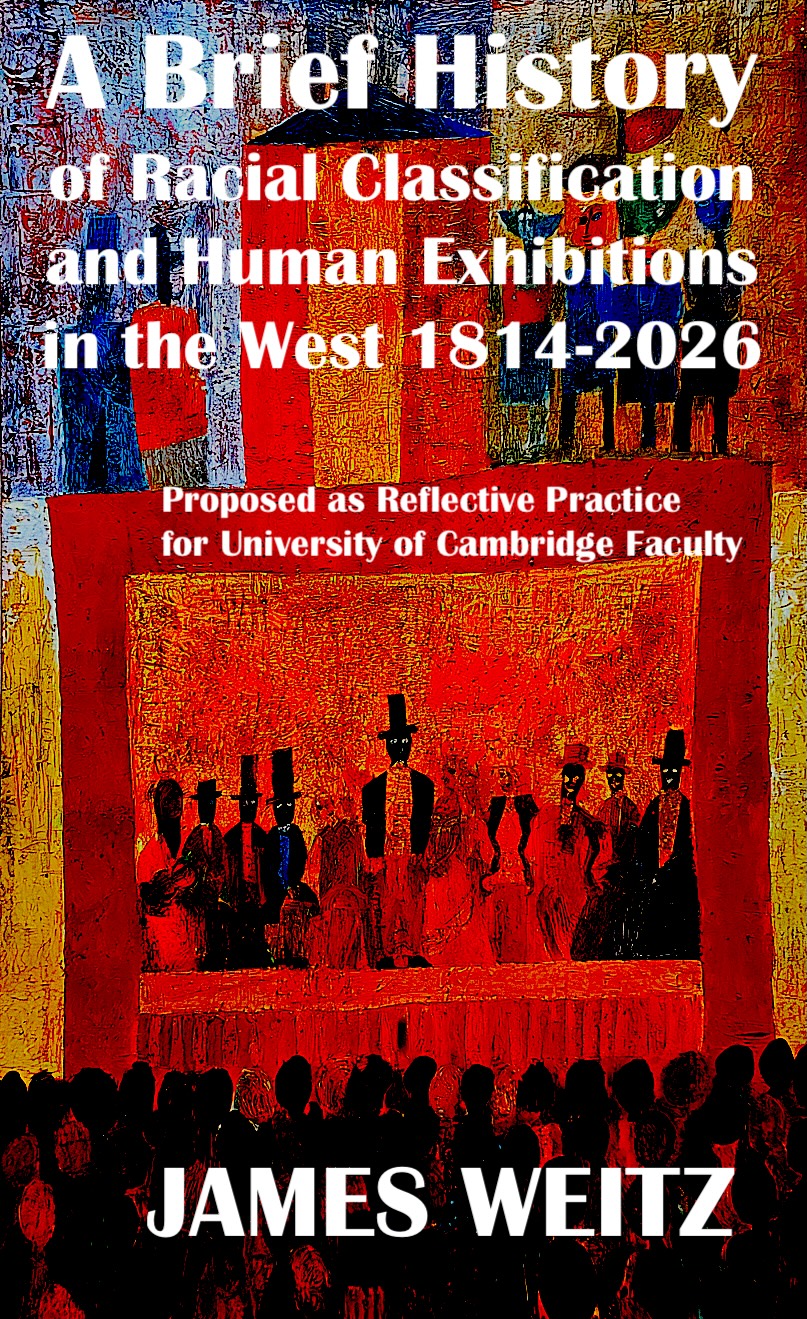
A BRIEF HISTORY OF RACIAL CLASSIFICATION AND HUMAN EXHIBITION IN THE WEST 1814-2026
Proposed as Reflective Practice for University of Cambridge Faculty
Click on the title to explore or download the free PDF pamphlet.
THE PALAIS-ROYAL
(PARIS) 1815
JEAN RÉAUX, THE ANIMAL SHOWMAN, gazed at the diminutive Khoekhoe woman, whom he was considering purchasing from the Englishman, Henry Taylor. She stood barely clothed on a stage a mere three feet in front of him. He raised his monocle and leaned in for a still closer inspection.
“Monsieur,” said Taylor, “observe her woolly hair, dark skin, large breasts and, of course, her bulging derriere that verily defies gravity. Such an exotic curiosity! Visitors would pay handsomely to view her.”
Réaux tore his attention away. “Is she human?” he asked.
Taylor shrugged and threw open his palms. “I suppose.”
“Does she speak?”
“Dutch.”
“Does she have a name?”
The Englishman took a moment to consult her papers. “Sara Baartman,” he said.
The animal showman turned back to the woman and looked at her with curiosity. “I have heard that in London a media campaign launched by one Zachary Macaulay led to a legal complaint of slavery.”
“Yes, but this was really nothing. Macaulay funded some do-good journalism to pressure the English courts. Baartman herself testified that she was brought from South Africa of her own free will. And of course … whatever protections she had in England do not apply here.” Taylor shifted nervously and quickly waved one hand through the air. “Anyway, shouldn’t France, as the seat of European culture, display a true noble savage to help the French stay as educated on race science as the British?”
The animal showman felt what little patriotic pride his small heart could hold. “Those are all sound points,” he said. “And the popular Palais-Royal would be the right venue to show her. We can find a place in the public galleries and exhibition spaces.”
“Then shall we complete the sale?”
“Yes. You know, I think we’ll put a collar on her. People will pay a good price, as you say.”
Taylor smiled.
Throngs of people crowded around … Look at her buttocks! … She’s all the rage! … She wears no dress! … They oohed and they aahed … I must show her at my luncheon … But of course, Mademoiselle. Everyone wants to see her—tout le monde! … Deliver her at my home in the Faubourg Saint-Germain at noon next Monday. In her cage, of course.
On the afternoon of the luncheon, the door of Sara’s small room off a noisy, crowded gallery walkway was locked from the inside. Sara was late for delivery.
“Force the door,” ordered Réaux.
One of his employees, a large man, threw his shoulder against it several times until it gave way. “For God’s sake!” exclaimed Réaux as he beheld Baartman lying motionless in bed. A putrid smell hit him in the face. “Call a doctor.”
#
Sara Baartman died after a week of what was described as an “inflammatory and eruptive sickness,” which may have been smallpox or syphilis, or a condition related to her heavy alcohol use and very poor living conditions. French naturalist Georges Cuvier made a full plaster cast of her body, preserving her brain and genitals in alcohol. These remains, along with the cast and her skeleton, were kept on display in the Museum of Man in Paris until 1974. They were repatriated to South Africa in 2002 at President Nelson Mandela’s request.
THE BRAZILIAN NATIONAL MUSEUM
(RIO DE JANEIRO) 1882
THE DIRECTOR OF THE NATIONAL MUSEUM, LADISLAU NETTO, walked into the staff meeting smiling and waving aloft a letter from the governor of Espiritu Santo province. “Great news! Our efforts have been rewarded. Governor Herculano Marcos Inglez de Souza has written to inform us that he has procured Indian savages for our Anthropological Exhibition this year, to be delivered with an interpreter well in advance of the inauguration.”
The director had reason to be proud. Obtaining wild Indians for the museum’s ethnographic zoo would be the highlight of his years-long effort to assemble an anthropological exhibit that would rival those of the museums in New York, Paris and London. Newspapers and science journals around the world would report on it, and the international reputation of both Netto and the Brazilian National Museum would be secured.
The staff gave a round of applause, and then one of them asked, “How many people are there and how should we care for them?”
The director’s expression turned serious and an awkward silence filled the room. “It is important to remember,” he said, “that we are not speaking of people. This is not a kidnapping. On the evolutionary hierarchy, the difference between the highest human race and these savages is greater than the difference between them and the non-human great apes.” The director’s visage brightened again. “But as to care, these bestial savages come from the Botocudo and Xerente tribes. As such, they are accustomed to basic clothes, beds and food, which they can prepare between performances of singing and dancing. It will be a great educational opportunity in race science for the public!”
#
The inauguration took place on July 29, the 36th birthday of Princess Isabel. She, Emperor Dom Pedro II and Empress Teresa Cristina were accompanied by a formal retinue in full gala attire. A band played the national anthem. Netto delivered an oration: the exhibition, he said, was a scientific achievement not just for Brazil, but for all the civilized world. Fireworks and military bands celebrated throughout the city.
The royal family toured the museum. But something was wrong. The Indians had been removed because, as the Gazeta de Noticias described it, the museum could not “reconcile the demands of the public and its ardent curiosity and at the same time to allow the Indians to walk through the halls of the anthropological exhibition and to dance and sing at will, without the shoving of which they had been victims.” And the satirical Revista Illustrada wrote, “So much interest in science amazes me; but I end up verifying that this curiosity of the visitors is only to see the Indians. … The poor Indians, the unfortunate ones, driven away by the Fluminense savagery, had long since taken refuge…”
Several days later the Emperor returned to view the Indians, who had been sheltered in a nearby fire brigade barracks for their safety. He watched as they were given physical and anthropometric examinations: head shape, skull proportions, skeletal features, tooth morphology. He had them transported to his residence for the remainder of their stay. Once their usefulness for the museum’s anthropological exhibit ended, they were returned home.
Months later, five of the same Botocudo Indians were kidnapped a second time and eventually found themselves on tour with the Grand Ethnological Congress of the Barnum & Bailey Circus. One of them, a woman named Nahen, died of typhoid pneumonia in Pittsburgh in October 1883.
THE BRONX ZOO
(NEW YORK), 1906
BRONX ZOO DIRECTOR WILLIAM HORNADAY sat in his well-appointed office and listened as Madison Grant, Secretary of the New York Zoological Society, read aloud a New York Times editorial that was supportive of Hornaday’s efforts to display a recently acquired pygmy in the Monkey House:
“We do not quite understand all the emotion which others are expressing in the matter. … It is absurd to make moan over the imagined humiliation and degradation Benga is suffering. The pygmies … are very low in the human scale, and the suggestion that Benga should be in a school instead of a cage ignores the high probability that school would be a place … from which he could draw no advantage whatsoever.”
Grant looked at Hornaday over the top of the newspaper and smiled wryly. “These are very much the thoughts I would have communicated to the editor, myself.” He set down the paper and leaned forward. “Your critics do not understand that the most humane thing for Benga is to keep him on display in his natural habitat.”
“The zoo and I certainly appreciate your support, Mr. Grant,” said Hornaday. “I do not understand all the brouhaha myself. Benga came to the 1904 World’s Fair from the Congolese rainforest, grateful to the American explorer who purchased him out of slavery. He was then happy enough here in the Monkey House until this negro, Reverend Gordon, alerted the media and started putting ideas in his head. Benga just yesterday began using his bow and arrow props to shoot at visitors outside his cage!”
Grant shook his head. “Senseless violence is a deep-seated part of the negro’s nature,” he said. “Anyway, after all is said and done, this is a great educational opportunity for our own people to understand their place in mankind’s racial hierarchy.”
“Yes, education is the main point. But would you believe that this Reverend Gordon fellow proposes to cap Benga’s sharpened teeth and educate him in Virginia??”
Madison Grant guffawed and shook his head.
#
Lynchburg, Virginia. Some years later.
Benga builds a ceremonial fire and dances round it with some locals looking on. He pulls off his teeth caps and from his mouth escape beautiful songs sung in his native language. Night falls. He walks to a nearby stable and retrieves a hidden gun from beneath a pile of hay…
New York Times
OTA BENGA, PYGMY, TIRED OF AMERICA
“Benga, [was] the first of the African pygmies to consent to leave his native wilds and the first who ever elected to remain in this country. … Finally, the burden of the white man’s civilization became too great for him to bear, and he sent a bullet through his heart.”
CAMBRIDGE UNIVERSITY,
(CAMBRIDGESHIRE, ENGLAND) LATE 2022
THE NINE MEMBERS OF THE BOARD OF ELECTORS met online to review the application of their favored candidate for the Chair in Sociology of Education in the Faculty of Education at Cambridge University. They wanted a black scholar who understood the whiteness problem. The board did not fully understand the problem themselves. But they did understand that high-profile diversity hires enhanced a university’s reputation and helped with funding.
Before the final vote on Dr. Jason Arday, Baroness Sally Morgan, the board chair and permanent member of the House of Lords appointed by Queen Elizabeth II, weighed in with her moderated sterile accent: “An extremely low percentage of Cambridge professors are black. It is therefore important that we center someone of African descent in front of our students to help educate them on the nefarious impact of whiteness. I believe Dr. Arday sums it up better than I can in this passage from his 2020 article in Times Higher Education. The Baroness read aloud: “Higher education institutions may see themselves as progressive, but ‘whiter than white’ would be a better description of their racial balance than of their moral character.”
“His scholarship is courageous,” someone added. “And Dr. Arday’s origin story is impressive in and of itself. He had to overcome great adversity as an autistic man to get where he is now.”
“But he is very young,” said another voice. “Only 37. The last Chair, Susan, was 20 years older than Dr. Arday when she was hired.”
“He has good references,” said the Baroness.
An uncertain voice piped up. “He has good references, but he does not have a degree in sociology.”
“No, but he has a PhD in education,” responded another board member. “And his work in autoethnography on race, education and inequality is first-rate.”
“And this problem of whiteness … exactly what will the students learn?”
“Well, just think about it,” said the Baroness sounding a bit annoyed.
“If nothing else, they will learn simply by observing a black man teach in front of them. It will be a great opportunity in race studies for the students.”
The board needed no more discussion before it voted unanimously to approve the hire. After all, Arday’s origin story was indeed impressive. And in no time, he was being hailed by the mainstream media as a new academic superstar.
Oooh, look at his four-foot dreadlocks … diagnosed with autism at 3 … non-verbal until age 11 … Illiterate until 18 … now Cambridge’s youngest black scholar appointed to a professorship … he ran 600 miles in six days … 30 marathons in 35 days and raised £5 million for charity … he had a stroke and lost his memory … he spent months in a coma after being hit by a car … he was on Seven Up!
#
Four years later, in the summer of 2026, Professor Hilary Cremin, head of the faculty of education, met with Dr. Arday in his office to discuss a problem.
“This man, Nathan Cofnas, is a pest,” she said. “The university got rid of him in 2024 and now, I’m afraid to tell you, he’s scrawled a vengeful article about you full of falsehoods.”
Dr. Arday shook his head almost mournfully. “I’ve read the article,” he said. “Cofnas is clearly acting out of insecurity by attacking me as a black man. This is a common behavior pattern among white supremacists.”
“I think that’s very insightful, Dr. Arday. I want you to know you have the full support of the faculty of education. We’ve defended you in various ways against attempted dishonest reporting in the past… But this time, I think a public statement should suffice to be rid of the problem. Cofnas’s obscure online blog will not carry the same weight with the public as the opinion of Cambridge and our allies in the UK mainstream media.”
#
On August 5, Cambridge announced that Arday would be investigated for academic misconduct. Arday resigned the same day. On August 12, the investigation was expanded to include “the circumstances around his appointment by the Faculty of Education.” On August 14, 2026, Jason Arday was found dead in a room in south London, likely by suicide. His fabulist memoir, Great and Unfortunate Things, nonetheless went on sale in mid-August as planned.
Hilary Cremin sat in her office and watched her computer screen with a vacant stare. Nathan Cofnas was answering questions about the Arday affair in an online interview with the obscure No BS with Brad Smith podcast out of Toronto, Canada. As she listened, she allowed herself to wonder how Jason’s race became such a focus for her, and really how inhuman is the life of a man who has no real friends to tell him not to lie. “[Cambridge] hired him when he was 37 years old,” Cofnas was saying, “and the retirement age is 68. So, what was the plan? To keep the story buried for 31 years? … They knew that he was a fabulist. It’s impossible to say that they didn’t know. They had three years to let him down gently. Instead, they tried to cover it up and made his humiliation as bad as possible. And then as soon as it was sufficiently embarrassing to the university, they just threw him under the bus and said we’re not protecting you, we’re starting an investigation and he’s out. … This is a story of DEI.”
ABOUT THE WRITER:
JAMES WEITZ is a writer and author of the novel, Gonzo Global Inc., a legal satire of globalization in which Mexican tap water is exported to the United States and sold as a laxative. He has lived in Asia and Latin America for most of the previous 20 years. During that time, Weitz has worked as a technical editor and taught ESL, composition and law at schools and universities in Latin America, and throughout the sinosphere. Previously, he worked on anti-corruption issues at the Organization of American States. His stories, essays and travel writing have appeared in multiple journals, Including the Mekong Review, TakiMag, Aporia Magazine, Open Journal of Arts and Letters, and many others. Weitz has a Master of Arts in Applied Linguistics with a focus on cross-cultural communication, and a Juris Doctor. Find him on X @James_Weitz10
Cover image: Bandanna Land: Opening Night at the Majestic (AI-assisted digital image) by O:JA&L staff creative. 2026. Public domain via Midjourney AI.
This project was made possible, in part, through support from
Richard Stimac and his new book BLOOD, WATER, AND STONE
available now from Spartan Press.

OJAL Art Incorporated, publishing since 2017 as OPEN: Journal of Arts & Letters (O:JA&L) and its imprints Buttonhook Press, HOT BUTTON PRESS Contemporary Issues, and HIGH BUTTON PRESS Contemporary Art, supports writers and artists worldwide.

The O:JA&L Free Presses Masters Series
The O:JA&L Free Presses Masters Series (from OPEN: Journal of Arts & Letters) gathers acclaimed writers for concise, downloadable chapbooks that pair fresh work with candid reflections on craft. Each installment—often framed by an interview with an associate editor—opens a window onto how masters of poetry, prose poetry, flash fiction, and related hybrid forms build voice, compression, and surprise. Designed as a reader’s invitation and a writer’s toolbox, the series celebrates literary art that moves fast, cuts deep, and lingers long after the last line.
Click on the titles below to explore or download the free PDF chapbooks.
Prose Poetry and Flash Discourse
The Buttonhook Press Masters Series:
Brian Clements on Prose Poetry
With an Interview by Associate Editor Pamelyn Casto
The Buttonhook Press Masters Series:
Mark Budman on Flash Fiction & Nonfiction
With an Interview by Associate Editor Pamelyn Casto
The Buttonhook Press Masters Series:
Ray Gonzalez on Prose Poetry
With an Interview by Associate Editor Pamelyn Casto
The Buttonhook Press Master Series:
Michael Martone on Flash Fiction
With an Interview by Associate Editor Pamelyn Casto
The Buttonhook Press Master Series:
Roberta Allen on Flash Fiction
With an Interview by Associate Editor Pamelyn Casto
The Buttonhook Press Master Series:
Peter Conners on Flash Fiction
With an Interview by Associate Editor Pamelyn Casto
The Buttonhook Press Masters Series:
Maxine Chernoff on Prose Poetry
With an Interview by Associate Editor Pamelyn Casto
The Buttonhook Press Masters Series:
Pedro Ponce on Flash Fiction
With an Interview by Associate Editor Pamelyn Casto
The Buttonhook Press Masters Series:
Kent Dixon on Flash Fiction & Nonfiction
With an interview by Associate Editor Pamelyn Casto
The Buttonhook Press Masters Series:
Tom Hazuka on Flash Fiction
With an interview by Associate Editor Pamelyn Casto
MIixed Forms: Haibun, Haiga, & Tanka Prose
The Buttonhook Press Masters Series:
Roberta Beary on Haibun
With an interview by Associate Editor Pamelyn Casto
Experimental Discourse
The Buttonhook Press Masters Series:
Jim Meirose on Experimental Discourse
With an interview by Associate Editor Warwick Newnham
Poetry: All forms & styles
The Buttonhook Press Masters Series:
Poetry from Bruce McRae
With an Interview by Associate Editor Jeff Streeby
The Buttonhook Press Masters Series:
Poetry from Richard Widerkehr
With an Interview by Associate Editor Jeff Streeby
The Dally Post Press Masters Series:
Rod Miller on Cowboy Poetry
With an Interview by Associate Editor Jeff Streeby
More titles in press

