

HAL: Heuristic Algorithmic Library
Poetry: All forms & styles
A Featured Series of Close Readings
SPEAKING THE OVERFULL WORLD:
A Close Reading of Bruce McRae’s Poem “All In”
Click on the title to download this free PDF pamphlet.
Click HERE to explore or download Bruce McRae’s poetry chapbook in the O:JA&L Masters Series.
Bruce McRae’s “All In” stages a poetics of radical inclusiveness, attempting to apprehend a universe so populous, heterogeneous, and excessive that it resists any definitive act of representation. At the level of literal statement, the poem assembles an expansive catalogue of beings, objects, events, and abstractions, all subsumed within a single order of existence. Its lexicon—terms such as animalcules, fustian badinage, cosmophobia, and simony—thickens the verbal texture of the poem’s world, lending it an atmosphere at once erudite, eccentric, and unruly. The title, All In, announces this totalizing impulse from the outset: the poem admits no principle of exclusion, incorporating the sublime and the sordid, the cosmic and the quotidian, the sacred and the grotesque. Although it offers no stable physical setting, it constructs a metaphysical field in which biological life, social disorder, violence, theology, and imaginative projection coexist. The speaker initially appears to occupy a position of contemplative survey, but the poem gradually reveals his implication in the very plenitude he describes. That movement is crucial, for the poem is concerned not merely with the scale of existence but with the limits of language and consciousness before such scale.
The poem articulates this epistemological pressure through its formal procedures as much as through its explicit assertions. Written in irregular free verse, “All In” rejects fixed rhyme and stable metrical pattern, thereby refusing the kinds of formal containment that might imply an ordered, hierarchized reality. Instead, McRae relies heavily on enjambment, allowing syntactic units to outrun the line and thus dramatize the poem’s resistance to closure. In the opening movement—“The great chain of being includes / the soul of the fly and American oligarch”—the line break produces a momentary suspension before the phrase expands outward into an improbable conjunction. Such continuities generate momentum, but McRae counterbalances them with fragments, abrupt declarative units, and accumulative list structures, so that the poem oscillates between propulsion and interruption. The stanzas themselves vary in length, creating provisional pauses rather than stable divisions. Formally, then, the poem does not merely describe boundlessness; it performs it, translating ontological excess into a reading experience structured by expansion, discontinuity, and recurrent overflow.
McRae’s diction intensifies that formal restlessness through a sustained collision of linguistic registers. Elevated philosophical phrasing such as “the great chain of being” is set beside starkly material or abject details—“a drunk in a ditch,” “some bloodied rag to chew”—so that the poem repeatedly collapses conventional distinctions between metaphysical speculation and bodily contingency. The vocabulary ranges from Latinate abstraction, as in “indecipherable,” “disillusionment,” and “hypothetical,” to monosyllabic, tactile nouns such as “bones,” “rag,” “snow,” and “thorns.” This lexical heterogeneity is not ornamental; it enacts the poem’s refusal to privilege one mode of being over another. Its syntax reinforces the same principle. Much of the poem proceeds paratactically, through the juxtaposition of phrases and clauses without extensive subordination or explanatory linkage, so that meaning emerges through adjacency rather than linear exposition. The catalogue becomes, in this sense, both a compositional strategy and a philosophical claim. Even the line “To wobble is human, to stumble divine” exemplifies the poem’s practice of estranging inherited formulas: by recasting the cadence of a familiar maxim into a more unstable proposition, McRae foregrounds disorder as a constitutive feature of existence. The poem does not argue discursively for interconnectedness; it produces that interconnectedness as an effect of syntax, sequence, and verbal pressure.
The poem’s figurative and imagistic field further elaborates this vision of total imbrication. Its governing trope, the “great chain of being,” invokes a classical cosmological model predicated on hierarchy and order; yet McRae radically revises that model by filling it with jarring, anti-hierarchical juxtapositions: “the soul of the fly and American oligarch,” “chicken bones and all-seeing eye,” “operas and atrocities.” The effect is less that of a stable chain than of a proliferating assemblage in which disparate ontological categories are forced into contiguity. Personification is central to this process. “Death is sewing its pretty party dress” domesticates and aestheticizes mortality without diminishing its force, while “light and water inventing the pear tree” recasts natural process as imaginative production. Such moments blur distinctions between the literal and the allegorical, the material and the animate. The sensory register of the poem is equally dense: “black thunder,” “a bowl of fruit,” “a red rocket landing / in the snow,” “dancing bears,” and “thistles and thorns” produce a sequence of sharply etched images whose rapid succession prevents any settled tonal orientation. Beauty, violence, wonder, and grotesquerie coexist without synthesis. As a result, the poem’s imagery does not stabilize meaning but proliferates it, rendering existence as sensorially saturated and affectively unstable.
Sound provides one of the principal means by which the poem secures coherence without sacrificing heterogeneity. McRae’s catalogues are not random accumulations but acoustically patterned sequences governed by repetition, echo, and cadence. Alliterative clusters such as “bloodied rag,” “brief interludes,” and “thistles and thorns” create local sonic bindings, while broader patterns of assonance and consonance confer a surprising musicality even on apparently incongruous combinations such as “jazz fusion and cosmophobia” or “Mule trains, cat flaps, boxcars, angels.” Although the poem does not submit to a regular meter, it develops a strongly marked rhythmic logic through iterative syntactic structures. Repeated openings—“There’s always…,” “I could…”—function almost as anaphoric pulses, generating a litany-like movement that gathers force across the poem’s later stanzas. This cumulative rhythm culminates self-reflexively in “the symphony’s blinding crescendo,” a phrase that names the very sonic enlargement the poem has been enacting. In this respect, sound is not merely decorative but structural: it is the medium through which multiplicity becomes temporarily apprehensible as pattern.
The poem’s decisive turn occurs when the speaker moves from catalogic observation to explicit implication: “Of course I’m in on it.” Up to this point, the voice has appeared to survey the world’s proliferating contents from a position of fascinated, if increasingly strained, spectatorship. With this admission, however, the speaker acknowledges his participation in the very processes of inclusion, violence, and becoming that he has been enumerating. The final movement intensifies that shift by converting the desire to name the world into a recognition of representational insufficiency. Even if the speaker could write “every atom on Earth” and describe “each molecule,” he would still fail to “contain you.” The concluding pronoun is deliberately expansive, at once intimate and cosmological, suggesting that neither the beloved, nor the world, nor being itself can be fully encompassed by language. McRae’s central claim, then, is not simply that existence is radically inclusive, but that such inclusiveness exceeds the capacities of taxonomy, lyric utterance, and human cognition. Through free verse, enjambed catalogue, lexical heterogeneity, personification, and accumulative sonic patterning, “All In” reimagines the great chain of being not as a legible hierarchy but as a modern condition of overwhelming interconnectedness. Its achievement lies in making formal excess itself the vehicle of thought: the poem knows the world precisely by demonstrating that it cannot finally contain it.
ABOUT BRUCE MCRAE:
BRUCE MCRAE, a Canadian musician, is a multiple Pushcart nominee with poems published in hundreds of magazines such as Poetry, Rattle and North American Review. The winner of the 2020 Libretto prize and author of four poetry collections and seven chapbooks, his poems have been broadcast and performed globally.
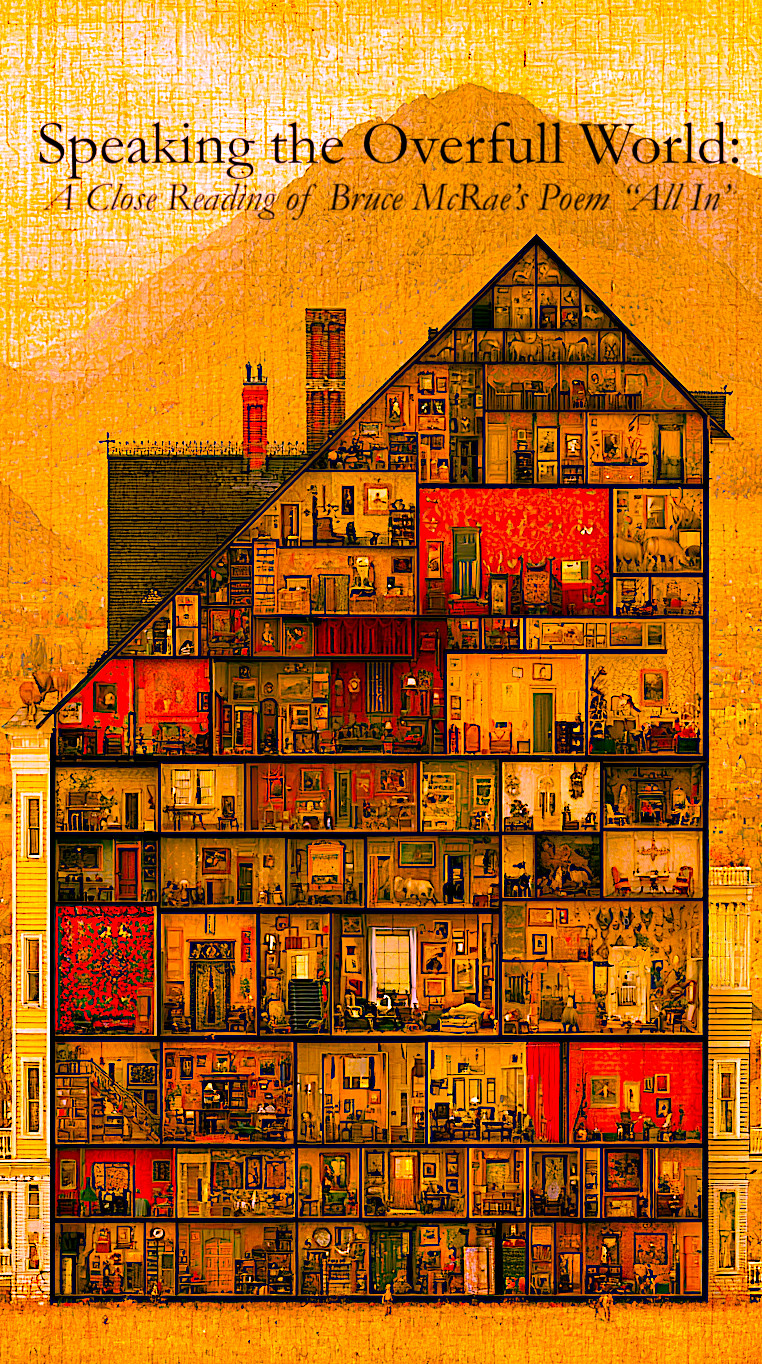
Image: Full House(AI-assisted digital image) by O:JA&L staff creative. 2026. Public domain via Midjourney AI.
This project was made possible, in part, through support from
Richard Stimac and his new book BLOOD, WATER, AND STONE
available now from Spartan Press.

OJAL Art Incorporated, publishing since 2017 as OPEN: Journal of Arts & Letters (O:JA&L) and its imprints Buttonhook Press, HOT BUTTON PRESS Contemporary Issues, and HIGH BUTTON PRESS Contemporary Art, supports writers and artists worldwide.

Click on the titles below to explore or download the free PDF pamphlets.
BUTTONHOOK PRESS PAMPHLET SERIES
2020
Safe Spaces: A Pretty Lie
Editorials on Issues of Poetic Practice by Rachel Custer
Against Art as a Radical Subjectivity
Editorials on Issues of Poetic Practice by Rachel Custer
Songs on the Way to God: A Theory of Poetics
Editorials on Issues of Poetic Practice by Rachel Custer
The Artistic Power of Silence: On Letting Art Speak for Itself
Editorials on Issues of Poetic Practice by Rachel Custer
Special Edition: Experimental Discourse
…are serious offenses, and…
A closet drama in two acts by Anthony Hamilton
How to Love a Headstone
Poetry by Sloane Asakura
The Last of the Gallants
Poetry by Atar Hadari
2021
Salt
Poetry by Amanda Leal
Deer in Fog at Twilight Near Squalicum Lake Road
Poetry by Richard Widerkehr
Democracy has Lifted Up Its Voice
Poetry by Mike Puican
2YC Review: The Works
Poetry and prose by members of the Two-Year College Caucus at AWP
Promises
Poetry by Ellis Elliott
Home
Poetry by Amanda Leal
Study of Burkas
A poem by Dana Sonnenschein
The Open Window
Flash vignettes by O.G. Rose
Light in the Cathedral: Russian/English Poems
Poetry in two languages by Andrey Gritsman
2022
Poems for Families
Poetry by Kirby Olson
Mogollon Rim
Poetry by Allisa Cherry
Hanno
Poetry by John-Michael Bloomquist
Poem scrawled on a maize-sheaf for her (last offering)
Poetry and art by Arturo Desimone
The Curve of the Open Page
A poem by Bruce Bond
Murder in the House: The “Nutshells” of Frances Glessner Lee
Poetry by Jessica Purdy
War and Riff
Haibun by Keith Polette
Family Photo of America
Poetry by Lynn Potts
Chester River Reverie
Poetry by Priscilla Long
Salton Sea
A short story by Mike Murray
The Fiddler
Poetry by Tim Hunt
A Balloon Called Young America
Poetry by Jennifer Clark
High Fashion
Featured Collaboration
Poetry by Adjei Agyei-Baah & Fine Art Photography by Jerome Berglund
2023
Rain Comes to the Central Valley
Poetry by Adrienne Pilon
DECIDUOUS
Poetry by Jean Kane
Potter’s Valley Road
Poetry (Americana) by Richard Widerkehr
Old Barn or How Things Go On
Poetry by Penelope Schotte
Nothing To Be Sorry For
Poetry by Lynn Cohen
Small Lantern
Featured Haiga Collaborations
Haiku: Hassane Zemmouri and Photography: Megali Bretou & Bea Bauer
A Sport and a Pastime
Haiku (Americana) by Ron Scully
Night Train
Haiku by Jerome Gagnon
The Aquarian Foundation
Poetry (Americana) by Jeffrey Gray
Once There Was a Way
Poetry by Steve Myers
Local Habitations
Poetry by Edison Jennings
Occasions for Listening (Excerpts from a WIP)
Spencer Silverthorne
2024
Needful Things
Micropoems by Ronald J. Scully (Americana)
Designation
Poetry by Wendy Taylor Carlisle
California Summer
Poetry by Michael Lee Johnson
Once Is Enough
Formalist poems by Peter Austin (Americana)
Garden
Poems by Jianquing Zheng (Americana)
Let Me Say This Up Front
Poetry by David James (Americana)
GEMS
Poems by Larry D. Thomas
BESTIARY
Poems by Larry D. Thomas
2025
WEST Toward Squalicum Mountain
Poems by Richard Weiderkehr
Mississippi River Delta: A Bestiary
Poems by Larry D. Thomas
A Week Late…
Haibun & Tanka Prose by Carolyn Martin
HOT BUTTON PRESS Contemporary Issues
2023
Lamentations: Icons of War
Arab-Israeli Conflict image-as-poem collection by Tony Brinkley
In Praise of Columbus
Poetry by Kirby Olson
Perseus with the Head of Medusa
Editorials on Issues of Contemporary Aesthetics by Contributing Editor Mick McGrath
Democrats by Trippin’
Editorials on Issues of Contemporary Aesthetics by Contributing Editor Mick McGrath
Let’s Talk About Female Academics
Editorials on Issues of Contemporary Aesthetics by Contributing Editor Mick McGrath
Diversophiles Everywhere!
Editorials on Issues of Contemporary Aesthetics by Contributing Editor Mike McGrath
The End of the “Black Victim” Narrative?
Editorials on Issues of Contemporary Aesthetics by Contributing Editor Mick McGrath
2024
Woes Innumerous (HOT BUTTON PRESS)
Based Fiction Mick McGrath (Americana)
2025
The Future Is Mao! (HOT BUTTON PRESS)
Short Fiction by Mick McGrath
Musing the Crossroads(HOT BUTTON PRESS)
Poems by Larry D. Thomas
SUPERFLUOUS SUPER LOUIS (HOT BUTTON PRESS)
Winner of the 2025 WEITZ PRIZE for Counter-Revolution Writing
Short Story by Perry Genovesi
Rule & Innovation (HOT BUTTON PRESS)
Short Fiction by Mick McGrath
