

HAL: Heuristic Algorithmic Library
Poetry: All forms & styles
A Featured Series of Close Readings
THE WORK OF LIVING
Memory, Loss, and Endurance in Lynsey France’s Home Again
A CLOSE READING OF A POEM BY LYNSEY FRANCE
Click HERE to read the poem “Home Again” by Lynsey France.
Click on the title THE WORK OF LIVING to down load the free PDF pamphlet.
In contemporary poetry, the trope of return often promises reconciliation: a coming home that restores coherence to self and place. Lynsey France’s Home Again deliberately unsettles this expectation. Rather than staging return as recovery or belonging, the poem confronts home as a site where loss accumulates, memory persists, and meaning resists resolution. Through free verse, compressed syntax, and an imagery field saturated with discarded objects and animal remains, France refigures home not as sanctuary but as a landscape that tests the limits of ethical and emotional endurance. The poem insists that grief is not something to be overcome or narratively resolved; it is something that inhabits bodies, objects, and environments alike.
France’s Home Again constructs survival not through healing or closure but through sustained attentiveness to what has been left behind. France’s formal looseness mirrors the pressure of memory, while her material imagery grounds grief in the physical world rather than abstract sentiment. By blurring boundaries between human and natural cycles and by staging care as partial, unfinished, and nevertheless necessary, the poem reframes return as an act of remaining—within loss, within place, and within language itself. In refusing consolation, Home Again offers a rigorous account of endurance, one in which meaning emerges not from redemption but from the ongoing labor of staying present to what has entered the irregular stages of perpetual decay yet refuses to disappear.
From its opening lines, Home Again establishes a world defined by accumulation and neglect. The speaker moves through “rural dumps” and spaces where “baby clothes with stains” lie abandoned, immediately framing the setting as one in which human and emotional waste coexist with the natural environment. These images are not merely descriptive; they create an ethical tension. What has been discarded still demands attention, and the speaker’s act of noticing becomes a form of reluctant caretaking. Home, in this sense, is not a sanctuary but a site of reckoning, forcing the speaker to confront what has been left behind and what refuses to disappear.
The poem’s free-verse structure reinforces this unsettled experience. There are no traditional stanzas or predictable pauses; instead, the poem unfolds in long, enjambed sentences that push relentlessly forward. This formal choice mirrors the speaker’s mental state. Memory does not arrive in neat units, and neither does the poem. The reader is carried along by syntax rather than meter, creating a sense of breathlessness that reflects the emotional weight of return. When shorter lines do appear—such as the stark declaration “Winter grew”—they do not offer relief so much as emphasize suspension. Time in the poem feels stalled between decay and renewal, echoing the speaker’s own inability to move cleanly beyond the past.
France’s diction consistently draws from a lexicon of damage and obscurity. Words such as “stains,” “broken,” “missing,” and “buried” recur, shaping a semantic field in which loss is ongoing rather than concluded. Importantly, these words are attached to physical objects, not abstract feelings. Grief is not named directly; it is embedded in matter. This grounding of emotion in tangible detail prevents the poem from becoming sentimental. Instead, it insists that loss is something one encounters materially—in soil, in discarded clothing, in animal remains—rather than something that can be neatly processed internally.
Imagery in Home Again frequently blurs the boundary between the human and the natural, suggesting that both are governed by similar cycles of abandonment and survival. Baby clothes are compared to “antlers shed,” aligning human growth and loss with natural processes. This comparison strips the image of sentimentality while also enlarging its meaning. The shedding of antlers is neither tragic nor celebratory; it is necessary. By invoking this image, the poem suggests that certain losses are inevitable, though no less painful for their inevitability. Nature does not redeem human grief, but it contextualizes it within a broader cycle of endurance.
One of the poem’s most striking metaphors appears near its conclusion, when meaning is described as emerging “like a clam bringing the pearl from a language grave.” Here, silence and decay become the conditions for fragile creation. Language itself is figured as something buried, requiring pressure and time to produce value. This metaphor reframes the poem’s dense imagery and difficult syntax as intentional labor: meaning must be wrested from what has been submerged. The poem does not present clarity as readily available; instead, it treats articulation as an act of resistance against erasure.
A crucial emotional shift occurs when the poem turns toward direct address, particularly in the line “I am still not your mother.” This statement introduces a complicated intimacy that reframes the preceding images. The “you” of the poem becomes more sharply defined, suggesting a relationship shaped by care that cannot be fully realized. The declaration acknowledges both desire and limitation: the speaker wants to protect, to nurture, but cannot undo what has already been lost. This moment resists sentimental consolation. Care does not erase grief; it exists alongside it, incomplete but necessary.
The poem’s final movement centers on the body as the site where memory threatens to overwhelm. Memory is figured as a “bloodstream,” something internal, circulating, and potentially dangerous if unchecked. The speaker’s effort “not to let it sink us” frames survival as collective and ongoing. There is no promise of healing, only the commitment to resist submersion. Importantly, this resistance is quiet rather than heroic. It takes the form of holding, listening, and remaining present. Endurance, the poem suggests, is not a dramatic overcoming but a sustained refusal to disappear.
By inconveniently denying a conventional resolution to the narrative arc, Home Again ultimately transforms the idea of return into a sustained and uncomfortable ethical posture rather than a moment of restoration and reconciliation. France’s dense imagery, unsettled syntax, and free‑verse structure work together to render grief as materially embedded and temporally unresolved. Home remains marked by neglect, memory continues to circulate within the body, and care is acknowledged as incomplete. Yet it is precisely this refusal of closure that gives the poem its clarity. Meaning, as the poem suggests, does not arise despite silence and burial but because of them—through pressure, patience, and resistance to erasure.
In this way, Home Again speaks against the cultural demand that grief culminate in healing or explanation. Instead, it honors endurance as a quiet, collective practice: holding, listening, and refusing to be submerged by memory’s force. The poem’s vision of survival is neither redemptive nor heroic; it is utilitarian, sustained, and provisional, grounded in attention to what persists. France thus reframes homecoming not as a return to wholeness, but as the ongoing work of living alongside loss without disappearing into it—a redefinition that positions survival itself as a meaningful, if fragile, form of home.
ABOUT LYNSEY FRANCE:
LYNSEY FRANCE is a young writer and textile artist living in Kentucky where she was born. Her work, whether physical or word form, resonates from the inspiration of what home brings within both one’s body and one’s surroundings.
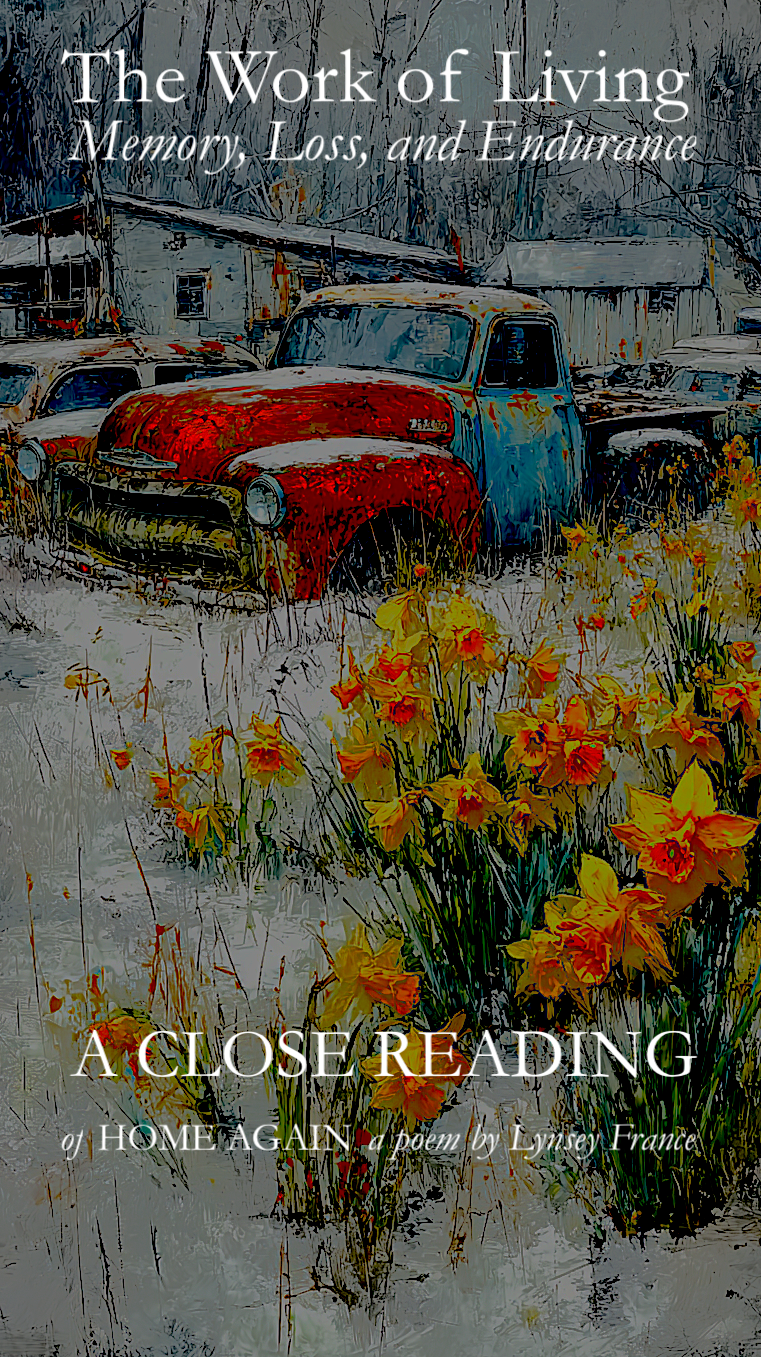
Cover image: Nobody Home (AI-assisted digital image) by O:JA&L staff creative. 2026. Public domain via Midjourney AI.
OJAL Art Incorporated, publishing since 2017 as OPEN: Journal of Arts & Letters (O:JA&L) and its imprints Buttonhook Press, HOT BUTTON PRESS Contemporary Issues, and HIGH BUTTON PRESS Contemporary Art, supports writers and artists worldwide.
O:JA&L’S BUTTONHOOK PRESS MASTERS SERIES
Click on the titles below to explore or download the free PDF chapbooks in the O:JA&L Masters Series.
The Buttonhook Press Masters Series: Brian Clements on Prose Poetry
With an Interview by Associate Editor Pamelyn Casto
The Buttonhook Press Masters Series: Mark Budman on Flash Discourse
With an Interview by Associate Editor Pamelyn Casto
The Buttonhook Press Masters Series: Ray Gonzalez on Prose Poetry
With an Interview by Associate Editor Pamelyn Casto
The Buttonhook Press Master Series: Michael Martone on Flash Fiction
With an Interview by Associate Editor Pamelyn Casto
The Buttonhook Press Master Series: Roberta Allen on Flash Fiction
With an Interview by Associate Editor Pamelyn Casto
The Buttonhook Press Master Series: Peter Conners on Flash Fiction
With an Interview by Associate Editor Pamelyn Casto
The Buttonhook Press Masters Series: Maxine Chernoff on Prose Poetry
With an Interview by Associate Editor Pamelyn Casto
The Buttonhook Press Masters Series: Pedro Ponce on Flash Fiction
With an Interview by Associate Editor Pamelyn Casto
The Buttonhook Press Masters Series: Tom Hazuka on Flash Fiction
With an interview by Associate Editor Pamelyn Casto
The Buttonhook Press Masters Series: Kent Dixon on Flash Fiction & Nonfiction
With an interview by Associate Editor Pamelyn Casto
MORE TITLES IN PRESS

