

HAL: Heuristic Algorithmic Library
Poetry: All forms & styles
A Featured Series of Close Readings
THE BURDENS OF INTIMACY:
A Close Reading of Richard Widerkehr’s Poem “Two Solitudes”
Click HERE to explore or download Richard Widerkehr’s free PDF chapbook WHAT ON EARTH?
Click HERE to download THE BURDENS OF INTIMACY, this close reading of “Two Solitudes.”
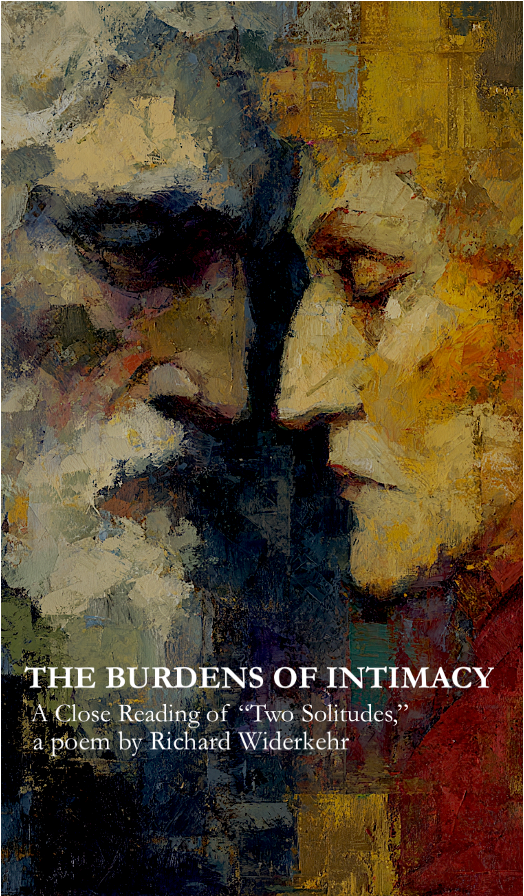
In “Two Solitudes,” Richard Widerkehr compresses a lifetime of emotional aftermath into a brief exchange remembered in sharp fragments. Widerkehr—an American poet who has published multiple collections and studied at Columbia University—often writes from the pressure point where private experience meets moral honesty, and that sensibility shapes this poem’s unsentimental tone. The speaker revisits a youthful encounter near “that tributary / of the Huron River,” then is jolted into the present by a letter that arrives “Fifty years later.” As the poem moves from a “jade heart / necklace” to the “stone image of the other” carried on their backs, it suggests that time does not necessarily heal; it can also harden memory into weight. Widerkehr’s closing refusals (“No, never.” “Do not…”) underline the poem’s central question: what does it mean to live with an unfinished connection without turning it into a comforting story?
Taken together, these biographical and stylistic contexts illuminate the poem’s governing claim: Widerkehr renders regret less as cathartic confession than as disciplined refusal. Through sustained second-person address (“You”), recurrent negation (“No, never.”), and an imagistic trajectory that moves from intimate ornament (the “jade heart / necklace”) toward impersonal heft (the “stone image”), the poem suggests how two lives may remain mutually formative while still fundamentally separate. “Two Solitudes,” accordingly, names not only interpersonal distance but also the peculiar endurance of memory—an attachment that persists without reconciling what it preserves.
With that framework in place, the opening stanza establishes the relationship as a recollection structured by shame and by the speaker’s resistance to converting that shame into narrative consolation, thereby introducing the poem’s central tension between intimacy and enduring separation. It begins with the blunt second-person charge—“You saw her shame”—which collapses temporal distance and frames the past as something for which the speaker remains answerable. The scene is rendered through hard-edged, industrial-inflected natural imagery—“a black trestle” spanning a “tributary / of the Huron River”—and the line “No locomotive’s shackled wheels” underscores absence: the expected engine of motion and progress is missing. When the poem then pivots—“Fifty years later, she writes”—the temporal leap occurs without release, implying that the past and present occupy the same psychological register. The speaker’s clipped reply—“No, never.”—followed by the phrase “slight melancholy” further resists melodrama; what persists is not spectacle but a quiet, corrosive remainder. The stanza thus positions the poem as an attempt to reckon with what has lasted—not romance, but an unresolved moral and emotional weight.
If the first stanza names the lingering ache, the second translates that regret into a single exchange and then amplifies it into the long labor of “carrying,” using concrete objects to figure how closeness becomes burden. The speaker recalls that “she unfastened her jade heart / necklace, closed it in your hands,” a tactile gesture that briefly renders intimacy both palpable and weighted. Yet the quoted interruption—“This won’t work,”—cuts across that tenderness with abrupt finality, and the speaker’s self-interrogating question, “Were there four, five other mornings?,” exposes memory as partial, provisional, and ethically unsettled. The stanza then slips into a dreamlike recurrence—“Headstones, / that river”—linking the earlier landscape to mortality, as though the encounter has become a private elegy that repeats rather than resolves. Most consequentially, Widerkehr recasts remembrance as physical exertion: “you both lug / on your backs this stone image of the other,” suggesting that each person has hardened the other into a fixed, burdensome emblem. The concluding image—“fingers almost touching”—condenses the poem’s defining pattern, a nearness that never becomes contact, and prepares the final stanza’s question of what time can (and cannot) burn away.
From that almost-touch, the final stanza turns to aging and pointedly refuses to convert long regret into a tidy, nostalgic epiphany; accordingly, it concludes in imperatives and negation. The figures are “old, heads bowed,” a posture that literalizes the poem’s emotional gravity, while “winter stars” are imagined as taking “the small, mute satisfaction of seeing what burns / away in clear, bright air.” The language of “burns away” and “clear, bright” gestures toward purification, as if time might clarify and cleanse the past. Yet the speaker withholds that satisfaction. Instead, he commands, “Do not ask,” and sharpens the prohibition: “No, / do not start a poem that ends, There used / to be more streetlights in the square.” The “streetlights” line functions as shorthand for an easy sentimental resolution (a brighter world, a simpler love), and Widerkehr rejects that rhetorical comfort as evasive. By ending on refusal, the stanza reaffirms the title’s premise: what remains is not reconciliation but separateness—two lives that never fully meet, even in the retrospective story the poem attempts to tell.
Precisely because the poem refuses a tidy moral, “Two Solitudes” argues that time can prolong a moment without transfiguring it—that regret may persist for decades without ripening into redemption. Widerkehr’s sustained second-person address (“You”) makes the lyric a form of self-prosecution, as though the speaker must return to the same scene to test both its meaning and its cost. The imagery charts a movement from intimacy to petrification: what begins as a “jade heart” placed in the speaker’s hands becomes, over time, “this stone image of the other,” implying that memory does not preserve a living person so much as fossilize them into a weight one carries. Even the poem’s light is ethically complicated. Although the “winter stars” might relish watching what “burns / away in clear, bright air,” the speaker refuses that purgative narrative, insisting instead on the integrity of what remains unresolved. The repeated negations—“No, never,” “Do not,” “No,”—register not merely despair but a commitment to honesty: the speaker will not close on a comforting account of how the world, or love, “used / to be” brighter. The poem’s insight, therefore, is austere but lucid: some distances endure, and whatever consolation exists lies in naming that fact without aestheticizing it.
Abou Richard Widerkehrt:
Richard Widerkehr’s fifth book of poems, Missing The Owl, is available from Shanti Arts Publications, as is his previous book, Night Journey. He has also published three chapbooks and one novel, Sedimental Journey (Tarragon Books). He received his M.A. from Columbia’s University, which he attended on a Woodrow Wilson Fellowship. His work has appeared in O:JA&L, Writer’s Almanac, Verse Daily, Atlanta Review, and many others. He won two Hopwood first prizes for poetry at the University of Michigan, three Sue C. Boynton awards, three prizes at The Bridge, and first prize for a short story at the Pacific Northwest Writers Conference. He has worked as a teacher in the Upward Bound Program at Western Washington University and, later, as a case manager with the mentally ill.
Image: Vis-a-Vis: Memory as a Burden of Regret (AI-assisted digital image) by O:JA&L staff creative. 2026. Public domain via Midjourney AI.
OJAL Art Incorporated, publishing since 2017 as OPEN: Journal of Arts & Letters (O:JA&L) and its imprints Buttonhook Press, HOT BUTTON PRESS Contemporary Issues, and HIGH BUTTON PRESS Contemporary Art, supports writers and artists worldwide.
O:JA&L’S BUTTONHOOK PRESS MASTERS SERIES
Click on the titles below to explore or download the free PDF chapbooks in the O:JA&L Masters Series.
The Buttonhook Press Masters Series: Brian Clements on Prose Poetry
With an Interview by Associate Editor Pamelyn Casto
The Buttonhook Press Masters Series: Mark Budman on Flash Discourse
With an Interview by Associate Editor Pamelyn Casto
The Buttonhook Press Masters Series: Ray Gonzalez on Prose Poetry
With an Interview by Associate Editor Pamelyn Casto
The Buttonhook Press Master Series: Michael Martone on Flash Fiction
With an Interview by Associate Editor Pamelyn Casto
The Buttonhook Press Master Series: Roberta Allen on Flash Fiction
With an Interview by Associate Editor Pamelyn Casto
The Buttonhook Press Master Series: Peter Conners on Flash Fiction
With an Interview by Associate Editor Pamelyn Casto
The Buttonhook Press Masters Series: Maxine Chernoff on Prose Poetry
With an Interview by Associate Editor Pamelyn Casto
The Buttonhook Press Masters Series: Pedro Ponce on Flash Fiction
With an Interview by Associate Editor Pamelyn Casto
The Buttonhook Press Masters Series: Tom Hazuka on Flash Fiction
With an interview by Associate Editor Pamelyn Casto
The Buttonhook Press Masters Series: Kent Dixon on Flash Fiction & Nonfiction
With an interview by Associate Editor Pamelyn Casto
MORE TITLES IN PRESS

