

Associate Editor Pamelyn Casto
A Close Reading of Franz Kafka’s
“Up in the Gallery”
Read the story here: http://www.kafka-online.info/up-in-the-gallery.html
Franz Kafka is known for works that explore alienation, helplessness, and isolation. Near the end of his life (in 1924), Kafka instructed his friend Max Brod to destroy his manuscripts. Fortunately for modern readers, Brod ignored this request, and much of Kafka’s work was published posthumously. Today, a mirrored statue of Kafka’s head stands in Prague, a reminder of the author whose strange, unsettling visions continue to inspire writers around the world.
This essay explores Franz Kafka’s memorable and unsettling short-short story “Up in the Gallery.” The piece has been analyzed and interpreted many times over, and that is because its simplicity and deep complexity accomplish so much in very few words.
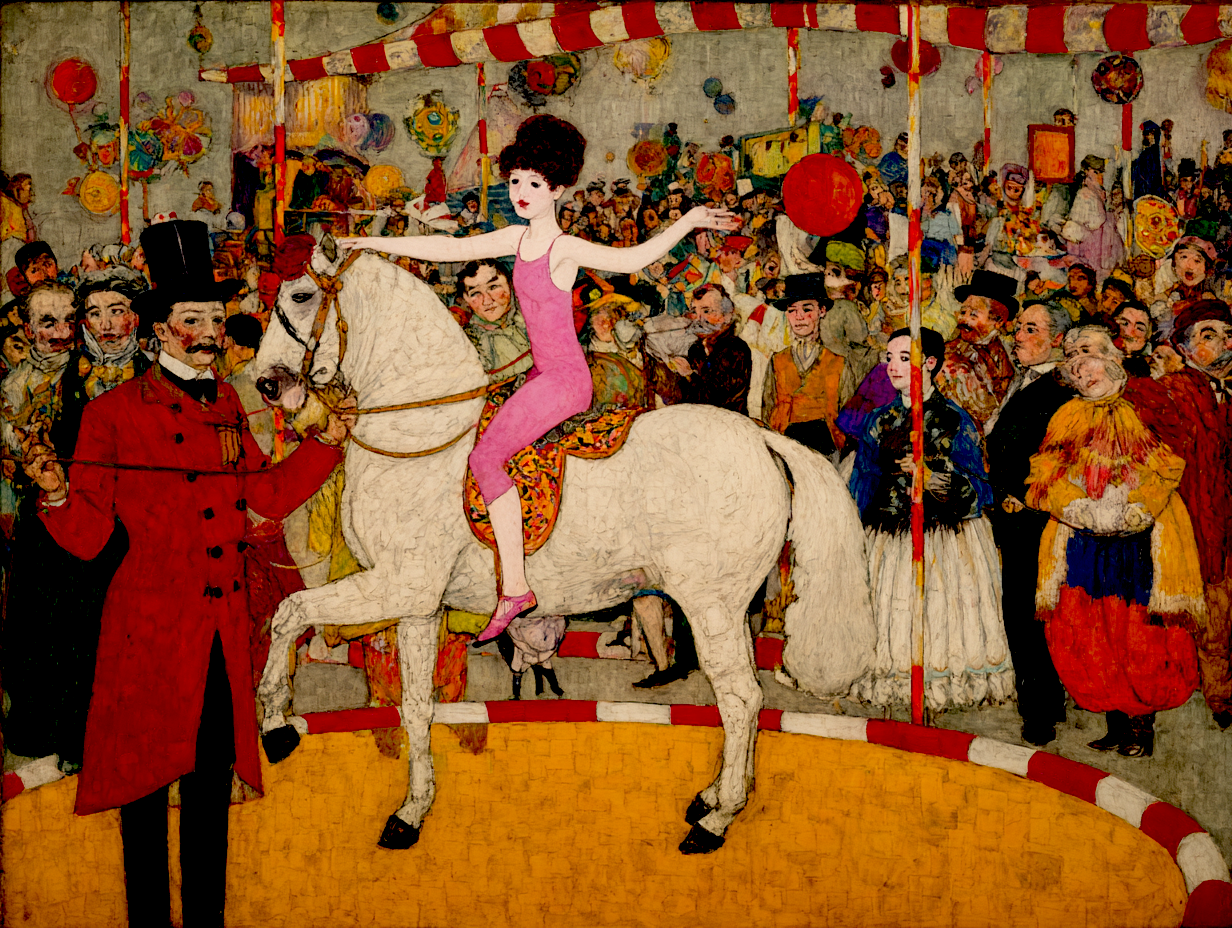
In just two paragraphs—each paragraph a single breathless sentence—Kafka offers two versions of the same circus scene in which a young man watches a woman perform on horseback under the direction of a ringmaster. The simple stories are both complicated and disturbing.
The first paragraph is a single subjective sentence. What’s presented is hypothetical, conditional, and contrary to fact. It’s written in the subjunctive mood– a string of “if… were to…” clauses that imagine a situation rather than report it. The spectator envisions a fragile, consumptive-looking woman performing in “anxious haste” under the direction of a whip-cracking ringmaster. The hypothetical scene is almost dreamlike. Yet within this imagined cruelty lies a strange sense of possible intervention on the part of the spectator. He could act on it by rushing down and yelling “Stop!” In this section of the story, the cruelty is recognized and can be acted upon because it’s clearly a morally threatening scenario.
The second paragraph, also just one sentence long, abruptly shifts from the subjunctive mood to the indicative mood and describes objective reality. The scene is now presented as “how things are”: the horsewoman appears cheerful, the orchestra plays with delight, the ringmaster seems to be protective of the woman, and he stands proudly in the arena as the woman laughs and rides in graceful circles. The verbs are immediate and factual.
At the end of the second paragraph, the young spectator does not or cannot intervene. Instead, he rushes to the railing, buries his face in his arms, and, drowned out by music, weeps. Here, the details are precise and sequential, yet the possibility of action has vanished; the young man can only witness and cry. He is helpless to change anything. He realizes he is dealing with surface appearances and cannot act upon the harsh and complex reality likely hiding behind them. The carefully staged surface conceals the cruel reality involved in the production of the circus show.
By juxtaposing a hypothetical scene of suffering that seems open to change with a vivid “real” scene in which nothing can be altered, Kafka inverts reader expectations. The imagined world feels more urgent, while the actual world feels fixed and immutable. Through the deliberate shift from subjunctive to indicative mood, Kafka transforms a simple circus scenario into a meditation on perception, helplessness, and the uneasy border between what we imagine and what we accept as reality. The mood change is thematic, affecting how readers experience urgency and resignation.
This brief exploration does not even come close to exhausting the many interpretations that have been put forth on this short-short story. It is most important to read the story, consider the meanings and possibilities you find, and explore how the piece achieves its memorable effects. A close and careful study can help improve your own writing.
About Pamelyn Casto:
Pamelyn Casto, twice a Pushcart Prize nominee, has published feature-length articles on flash fiction in Writer’s Digest (and in their other publications), Fiction Southeast, and Writing World (and elsewhere). Her essay on flash fiction and myth appears in Rose Metal Press’s Field Guide to Writing Flash Fiction: Tips from Editors, Teachers, and Writers in the Field and her 8,000-word essay on flash fiction is included in Books and Beyond: The Greenwood Encyclopedia of New American Reading (4 volumes). She also has a 5,000-word article on flash fiction as the lead article in the new book Critical Insights: Flash Fiction. Subscribe to her free online monthly FlashFictionFlash newsletter (first issue published in 2001) for markets, contests, and publishing news for flash literature writers. Casto is an Associate Editor at O:JA&L. Pamelyn Casto’s new book Flash Fiction: Alive in the Flicker (A Portable Workshop), a new release from O:JA&L’s Buttonhook Press, is available now on Amazon. Explore more in Pamelyn Casto’s featured series of close readings: Pamelyn Casto: A Featured Series of Close Readings.
About FRANZ KAFKA: Franz Kafka (1883-1924) was a Jewish Czech writer born in Prague. He is widely regarded as a major figure of Twentieth Century literature whose writings blend elements of realism with surreal elements to achieve unique effects.
Image: Circus! Circus! (AI-assisted digital image) by O:JA&L staff creative. 2025. Public domain via MidJourney AI.
OJAL Art Incorporated, publishing since 2017 as OPEN: Journal of Arts & Letters (O:JA&L) and its imprints Buttonhook Press, HOT BUTTON PRESS Contemporary Issues, and HIGH BUTTON PRESS Contemporary Art, supports writers and artists worldwide.
Explore O:JA&L’s Buttonhook Press offerings on Amazon.
Subscribe to the O:JA&L YouTube channel.
Become an O:JA&L Member through Patreon.
Follow O:JA&L on Facebook.
Support Pamelyn Casto’s text for writers: Flash Fiction: Alive in the Flicker
Support O:JA&L’s free presses.

